Laravel enhances its Context system with new increment and decrement methods, providing an elegant solution for tracking counters and metrics across your application without complex state management.
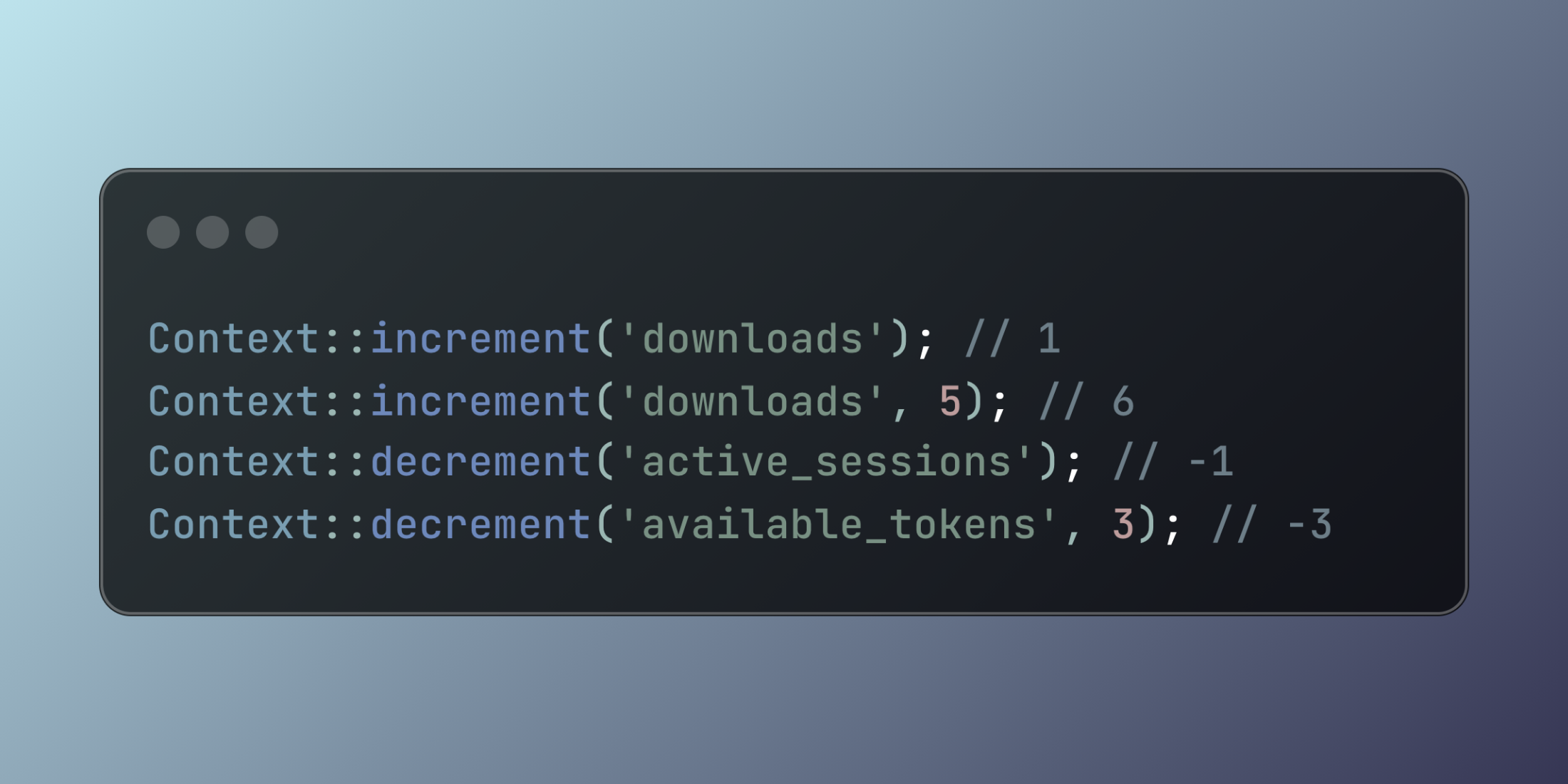
The Context system now allows developers to easily maintain numerical values with simple, expressive syntax:
// Initialize or increment a counterContext::increment('downloads'); // 1Context::increment('downloads'); // 2 // Increment by a specific amountContext::increment('downloads', 5); // 7 // Decrement countersContext::decrement('active_sessions'); // -1Context::decrement('available_tokens', 3); // -3These methods prove particularly valuable when monitoring application metrics or resource consumption:
class DocumentController extends Controller{ public function download(Request $request, $id) { // Increment total download attempts Context::increment('metrics.download_attempts'); try { // Validate user permissions $request->validate([ 'subscription' => 'required|active', ]); $document = Document::findOrFail($id); // Increment successful downloads counter Context::increment('metrics.successful_downloads'); // Track bandwidth usage $size = $document->size; Context::increment('metrics.total_bandwidth', $size); return Storage::download($document->path); } catch (ValidationException $e) { // Increment permission rejection counter Context::increment('metrics.permission_rejections'); throw $e; } catch (\Exception $e) { // Increment error counter Context::increment('metrics.download_errors'); throw $e; } }}Middleware can then capture and log these metrics at request completion:
class MetricsLoggerMiddleware{ public function handle($request, $next) { $response = $next($request); // Log the metrics at request end $this->logMetrics(); return $response; } protected function logMetrics() { // Collect metrics from context $downloadAttempts = Context::get('metrics.download_attempts', 0); $successfulDownloads = Context::get('metrics.successful_downloads', 0); $permissionRejections = Context::get('metrics.permission_rejections', 0); $downloadErrors = Context::get('metrics.download_errors', 0); $totalBandwidth = Context::get('metrics.total_bandwidth', 0); // Log the collected metrics Log::info('Download Metrics', [ 'attempts' => $downloadAttempts, 'successful' => $successfulDownloads, 'permission_denied' => $permissionRejections, 'errors' => $downloadErrors, 'bandwidth_used' => $totalBandwidth, ]); }}These new Context methods enable clean, maintainable counter implementation throughout Laravel applications without resorting to global variables or complex state tracking patterns.