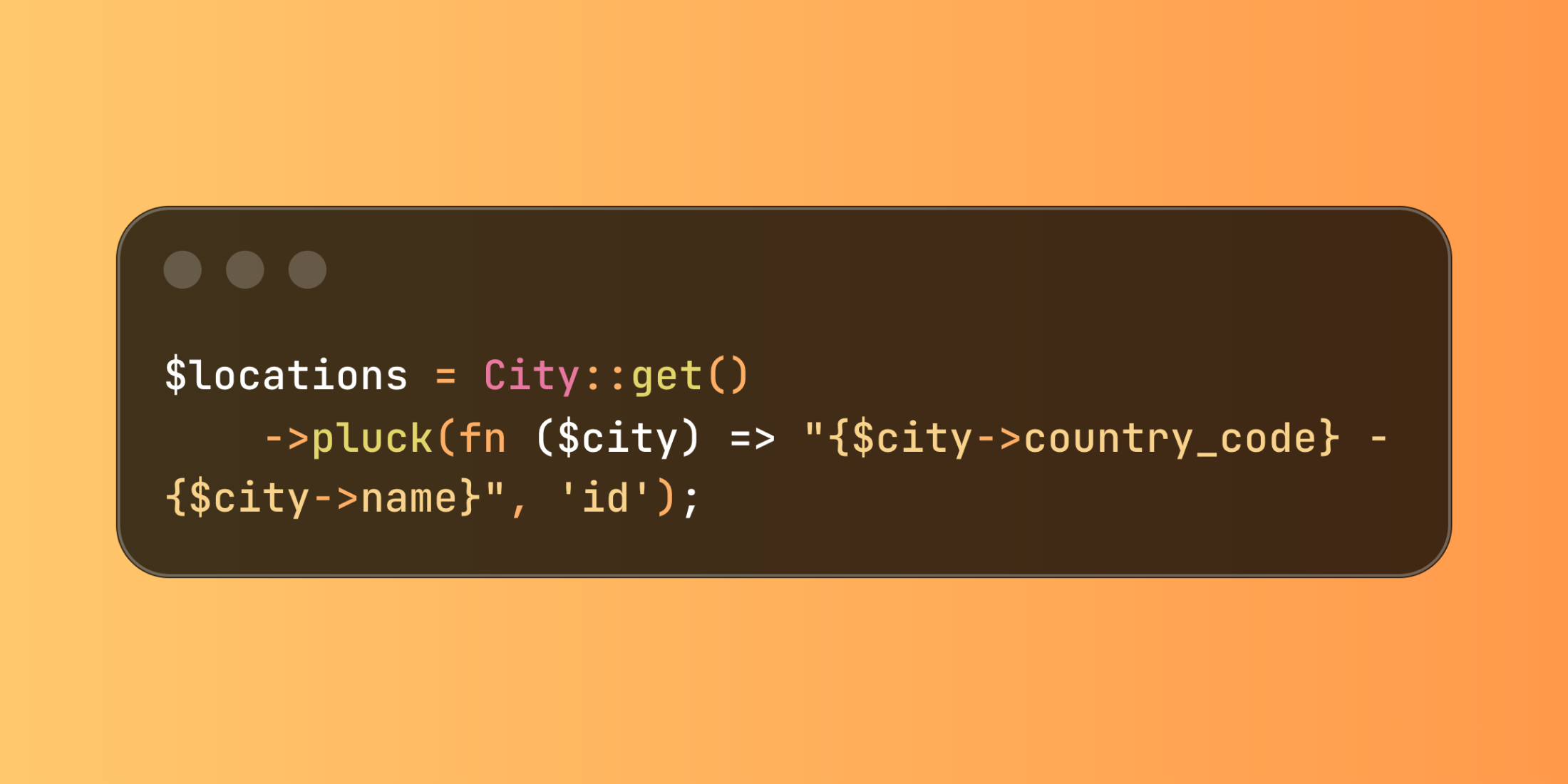
Laravel's collection pluck() method now accepts closures for both key and value parameters, eliminating the need for verbose mapWithKeys() approaches when applying simple transformations during data extraction.
Previously, transforming data while plucking required abandoning the clean pluck() syntax in favor of more complex collection methods:
$locations = City::get()->mapWithKeys(function ($city) { return [$city->id => "{$city->country_code} - {$city->name}"];});The enhanced pluck() method streamlines this process with closure support:
$locations = City::get() ->pluck(fn ($city) => "{$city->country_code} - {$city->name}", 'id');Consider an inventory management system where product listings need formatted display values:
<?php namespace App\Services; use App\Models\Product;use App\Models\Category; class InventoryService{ public function getFormattedProducts() { $products = Product::with('category')->get() ->pluck(fn ($product) => "#{$product->sku} - {$product->name}", 'id'); return $products; } public function getPricedInventory() { $inventory = Product::active()->get() ->pluck(fn ($product) => '$' . number_format($product->price, 2), 'sku'); return $inventory; } public function getCategorizedItems() { $categories = Category::with('products')->get() ->pluck('name', fn ($category) => str_slug($category->name)); return $categories; }}This approach works seamlessly in view contexts where formatted data is essential. Building select dropdowns becomes more straightforward:
$productOptions = Product::available()->get() ->pluck(fn ($product) => "{$product->brand} {$product->model}", 'id');<select name="product_id" class="form-control"> @foreach($productOptions as $id => $displayName) <option value="{{ $id }}">{{ $displayName }}</option> @endforeach</select>The closure support handles various transformation needs without requiring complex mapping operations. You can concatenate fields, apply formatting functions, add prefixes or suffixes, and create dynamic keys based on model properties. This maintains the familiar pluck() interface while providing the flexibility previously available only through more verbose collection methods.