There are a lot of important components needed to run a successful web application. The language you code it in, which developers are working on the project, and the integrations with other services are enormous aspects of the process. One essential part of running an application, however, is monitoring. Seeing precisely what’s going on in your application can be incredibly useful when it comes to fixing errors, debugging performance issues, and seeing which users are experiencing problems with response times. APM tools (Application Performance Monitoring) are a great way to receive data on your application regarding what’s causing performance slow-downs.
What are External Services?
An external service is anything that makes an HTTP request to another host. Stripe, a payment processing software, is an excellent example of an external service. An application makes an HTTP call to Stripe’s API providing a customer ID, and Stripe will charge the customer their monthly subscription.
Benefits of External Services Monitoring
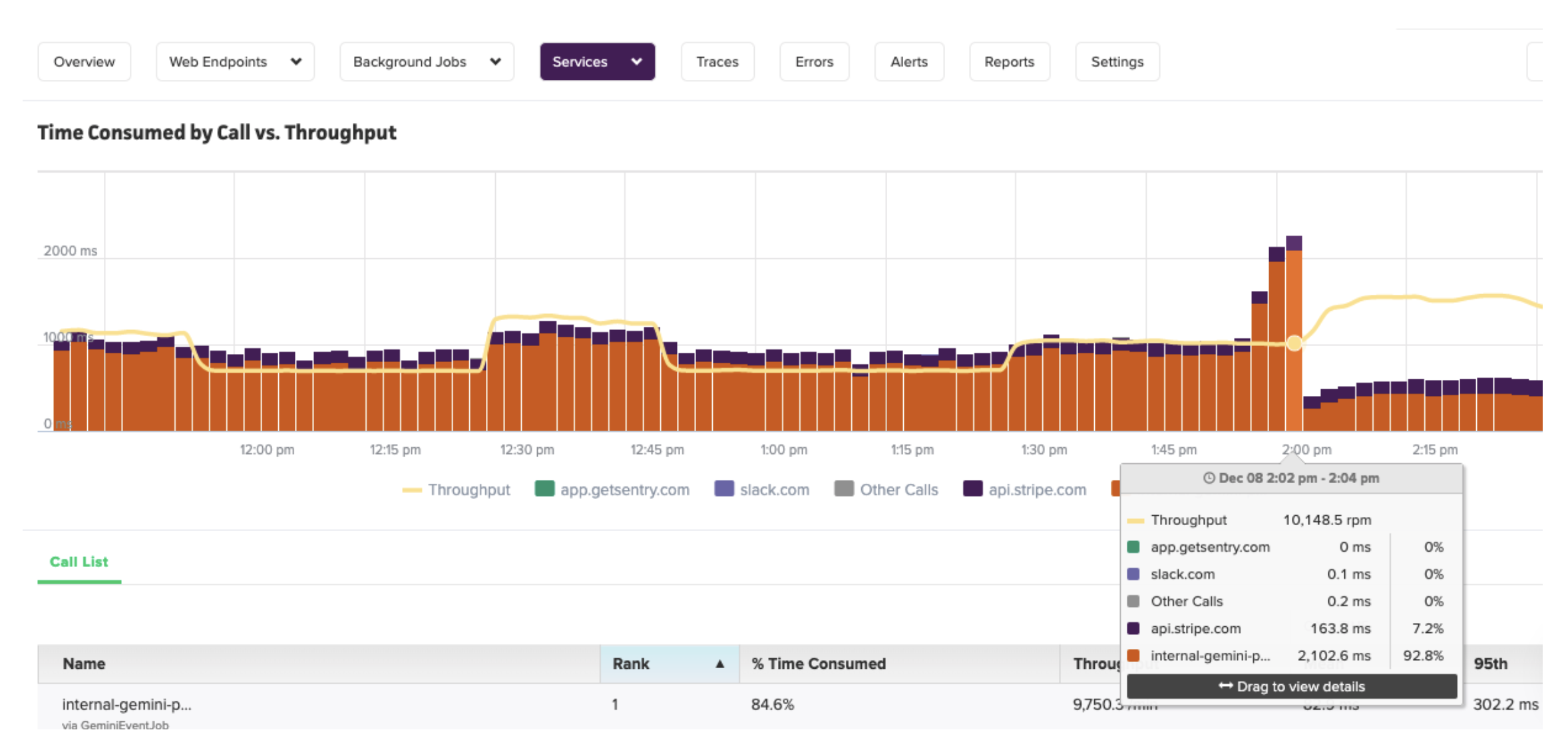
With the rise of microservices, the API economy, and the proliferation of SaaS services, monitoring External Services is more important than ever. Monitoring requests such as these in detail gives you another level of granularity when it comes to HTTP requests and API calls. You can receive information regarding how much throughput and response time certain API calls to these external services take and how each affects the rest of your application - and exactly which endpoints in your application are making which type of calls to these external services.
This can be extremely valuable when external services monitoring allows a developer to see if a 3rd party hosted service is causing slow-downs of your own application. When one of these services becomes slower it can cause performance issues within your application, and you may not have control over resolving the performance issue of a 3rd party service. Trying to find which request caused issues without an APM can be like finding a needle in a haystack. Seeing when these API calls are causing these problems through your APM allows you to identify or even eliminate the root cause of what might be slowing something down.
Conclusion
Nearly all applications developed today utilize external services via HTTP API integrations. External service monitoring is now, more than ever, an instrumental component of your chosen APM tool. It gives you deeper insight into factors that could be slowing down your application, and it allows you to find and fix issues quickly. Check out Scout APM’s external service monitoring add-on for Ruby, Python, and PHP applications by starting a 14-day free trial today!