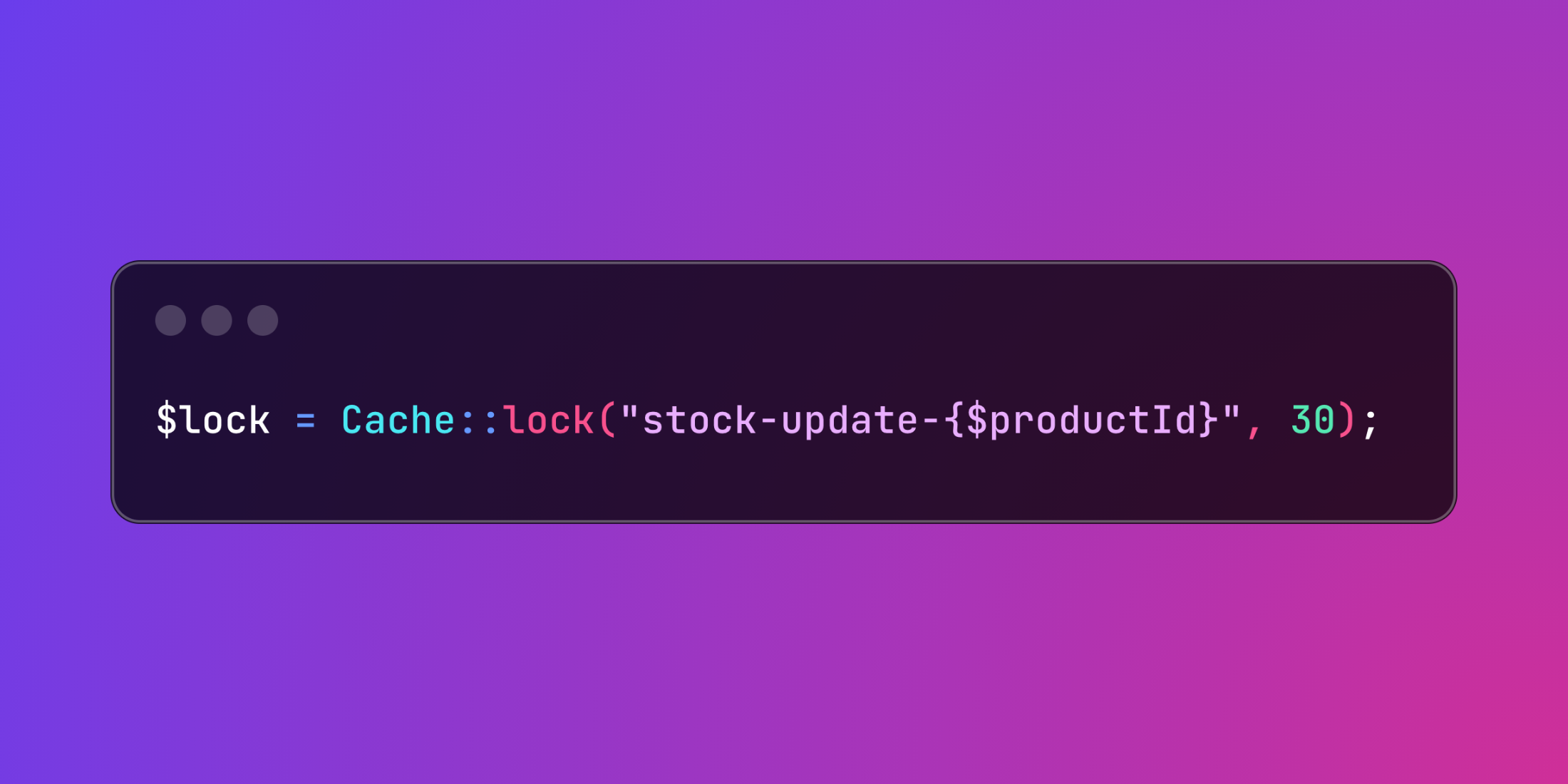
Concurrent operations in distributed systems often create challenging scenarios where multiple processes attempt to modify shared resources simultaneously. Laravel's Cache::lock() provides an elegant solution for implementing atomic locks that ensure exclusive access to critical code sections across multiple servers and worker processes.
Distributed locks prevent race conditions by guaranteeing that only one process can execute specific operations at any given time. This mechanism maintains data integrity and prevents the unpredictable behaviors that arise from concurrent modifications.
use Illuminate\Support\Facades\Cache; class InventoryUpdater{ public function updateStock($productId, $quantity) { $lock = Cache::lock("stock-update-{$productId}", 30); if ($lock->get()) { try { $this->performStockUpdate($productId, $quantity); } finally { $lock->release(); } } else { Log::warning("Stock update already in progress for product {$productId}"); } } private function performStockUpdate($productId, $quantity) { $product = Product::find($productId); $product->stock_quantity += $quantity; $product->save(); }}The lock mechanism works by creating a named lock with a specified duration. When a process successfully acquires the lock, other processes attempting to obtain the same lock will fail until the first process releases it or the lock expires automatically.
Cache locks integrate seamlessly with various cache drivers including Redis and Memcached, providing flexibility in distributed architectures. The automatic expiration feature prevents indefinite locks when processes fail unexpectedly, ensuring system reliability.
Consider implementing a financial transaction processor that must prevent duplicate payments and ensure accurate balance calculations. Atomic locks provide the necessary synchronization to maintain financial integrity across concurrent operations.
class PaymentProcessor{ public function processPayment($userId, $amount, $transactionId) { $lock = Cache::lock("payment-{$userId}", 60); if ($lock->get()) { try { Log::info("Processing payment for user {$userId}"); $user = User::find($userId); if ($user->account_balance < $amount) { throw new InsufficientFundsException(); } $user->account_balance -= $amount; $user->save(); Transaction::create([ 'user_id' => $userId, 'amount' => $amount, 'transaction_id' => $transactionId, 'status' => 'completed' ]); $this->sendPaymentConfirmation($user, $amount); Log::info("Payment processed successfully for user {$userId}"); } catch (\Exception $e) { Log::error("Payment processing failed: " . $e->getMessage()); throw $e; } finally { $lock->release(); } } else { Log::info("Payment processing already in progress for user {$userId}"); throw new PaymentInProgressException(); } } private function sendPaymentConfirmation($user, $amount) { Mail::to($user)->send(new PaymentConfirmation($amount)); }}The payment processor demonstrates several critical aspects of atomic lock usage. The lock duration is set to 60 seconds, providing sufficient time for the complete transaction while preventing indefinite locks. The try-finally block ensures lock release regardless of operation success or failure.
When the lock cannot be acquired, the system logs the attempt and throws an appropriate exception rather than silently failing. This approach provides transparency and allows calling code to handle concurrent processing scenarios appropriately.
Laravel's atomic cache locks offer robust protection against race conditions with minimal performance overhead. The automatic expiration mechanism and driver flexibility make them suitable for various distributed system architectures where data consistency is paramount.