Laravel's toUri() method transforms string-based URL extraction into fluent URI manipulation, enabling dynamic parameter addition and modification through method chaining.
Traditional URL processing requires complex string manipulation and parsing logic:
$text = 'Visit {https://api.service.com/endpoint} for data access.';preg_match('/\{(.*?)\}/', $text, $matches);$baseUrl = $matches[1];$finalUrl = $baseUrl . '?' . http_build_query($params);The new approach streamlines this into readable, chainable operations that integrate with Laravel's string helpers.
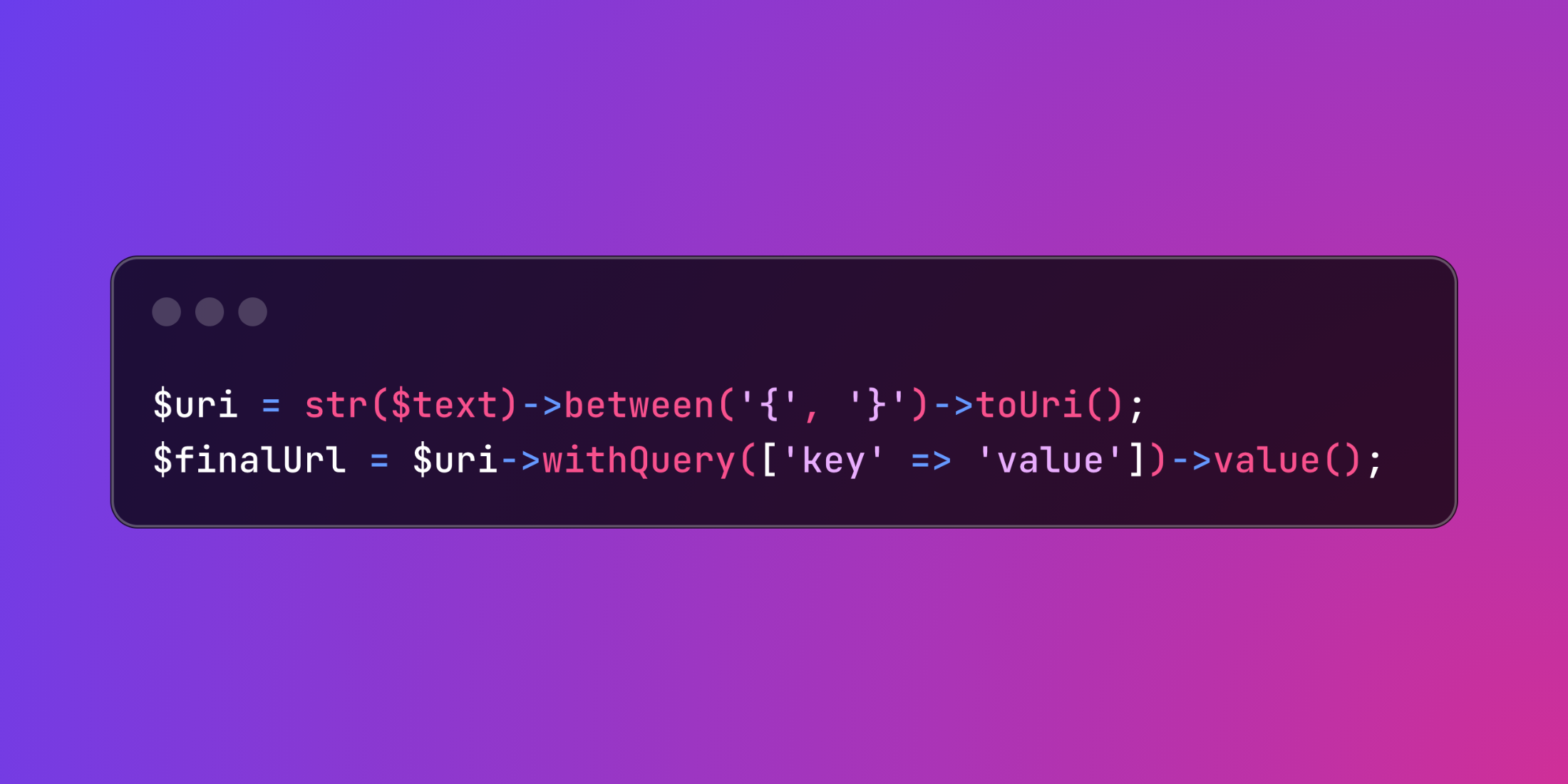
$uri = str($text)->between('{', '}')->toUri();$finalUrl = $uri->withQuery(['key' => 'value'])->value();Here's a comprehensive notification system demonstrating various URI manipulation scenarios:
class NotificationService{ public function processEmailTemplate(string $template, User $user): string { $actionUrl = str($template) ->between('[ACTION_URL]', '[/ACTION_URL]') ->toUri(); if ($user->hasRole('premium')) { $actionUrl = $actionUrl ->withQuery(['tier' => 'premium']) ->withQuery(['features' => 'advanced']) ->withFragment('dashboard'); } else { $actionUrl = $actionUrl ->withQuery(['tier' => 'basic']) ->withQuery(['upgrade' => 'available']); } $trackingUrl = $actionUrl ->withQuery(['utm_source' => 'email']) ->withQuery(['utm_campaign' => 'user_engagement']) ->withQuery(['user_id' => $user->id]); return str($template)->replace( '[ACTION_URL]' . str($template)->between('[ACTION_URL]', '[/ACTION_URL]') . '[/ACTION_URL]', $trackingUrl->value() ); } public function generateApiEndpoints(array $baseUrls, array $parameters): array { $endpoints = []; foreach ($baseUrls as $service => $url) { $uri = str($url)->toUri(); $uri = $uri->withQuery(['api_version' => $parameters['version'] ?? 'v1']) ->withQuery(['format' => $parameters['format'] ?? 'json']); if (isset($parameters['auth_token'])) { $uri = $uri->withQuery(['token' => $parameters['auth_token']]); } if (isset($parameters['timeout'])) { $uri = $uri->withQuery(['timeout' => $parameters['timeout']]); } $endpoints[$service] = $uri->value(); } return $endpoints; } public function buildDownloadLinks(Collection $files, string $baseTemplate): Collection { return $files->map(function ($file) use ($baseTemplate) { $downloadUri = str($baseTemplate) ->replace('{FILE_ID}', $file->id) ->toUri(); $downloadUri = $downloadUri ->withQuery(['expires' => now()->addHours(24)->timestamp]) ->withQuery(['signature' => $this->generateSignature($file)]) ->withQuery(['download' => 'true']); if ($file->requires_authentication) { $downloadUri = $downloadUri->withQuery(['auth' => 'required']); } return [ 'file_id' => $file->id, 'name' => $file->name, 'download_url' => $downloadUri->value(), 'expires_at' => now()->addHours(24)->toISOString() ]; }); } public function createWebhookUrls(string $configTemplate, array $webhookData): array { $webhooks = []; foreach ($webhookData as $event => $endpoint) { $webhookUri = str($configTemplate) ->replace('{ENDPOINT}', $endpoint) ->toUri(); $webhookUri = $webhookUri ->withQuery(['event' => $event]) ->withQuery(['secret' => $this->generateWebhookSecret()]) ->withQuery(['version' => '2024-07']); if ($event === 'payment_completed') { $webhookUri = $webhookUri ->withQuery(['priority' => 'high']) ->withQuery(['retry_count' => '3']); } $webhooks[$event] = [ 'url' => $webhookUri->value(), 'secret' => $this->generateWebhookSecret(), 'events' => [$event] ]; } return $webhooks; } private function generateSignature($file): string { return hash_hmac('sha256', $file->id . $file->name, config('app.key')); } private function generateWebhookSecret(): string { return 'whsec_' . bin2hex(random_bytes(24)); }} class RedirectController extends Controller{ public function buildRedirectUrl(Request $request): string { $baseRedirect = 'https://app.example.com/dashboard'; $redirectUri = str($baseRedirect)->toUri(); if ($request->has('campaign')) { $redirectUri = $redirectUri->withQuery(['utm_campaign' => $request->input('campaign')]); } if ($request->has('source')) { $redirectUri = $redirectUri->withQuery(['utm_source' => $request->input('source')]); } if (auth()->check()) { $redirectUri = $redirectUri ->withQuery(['user' => auth()->id()]) ->withFragment('welcome'); } else { $redirectUri = $redirectUri->withFragment('login'); } return $redirectUri->value(); }}The toUri() method simplifies URL manipulation while maintaining Laravel's fluent interface conventions, making complex URI construction both readable and maintainable.