Laradocs is a Laravel package that serves a documentation site from markdown files kept inside your codebase. You write the docs next to the code they describe, commit them together, and Laradocs renders them at /docs with navigation, search-friendly metadata, and a responsive UI.
- Multi-level file structure — nested folders become nested navigation.
- Filename or metadata routing — slug: front-matter overrides paths.
- Markdown → HTML powered by CommonMark (GFM, tables, footnotes, …).
- Rich per-file metadata — title, description, order, hidden, group, badge, redirect, tags, and more.
- Polished default UI — responsive, dark-mode, sidebar, breadcrumbs, on-page table of contents, prev/next — all publishable and overridable.
- Smart caching — rendered HTML cached and auto-invalidated on file change.
- And more
Folder Structure Becomes Navigation
Laradocs builds its sidebar from your directory layout. Nested folders turn into sections, and an _index.md file acts as a section's landing page. Routing follows the filenames by default, but you can override a path with a slug field in front-matter when you want a URL that differs from the file location.
Scaffold a new page with the generator command:
php artisan make:doc guide/getting-started --title="Getting Started" --order=1Front-Matter Metadata
Each page carries metadata in YAML front-matter that controls how it appears in navigation and search:
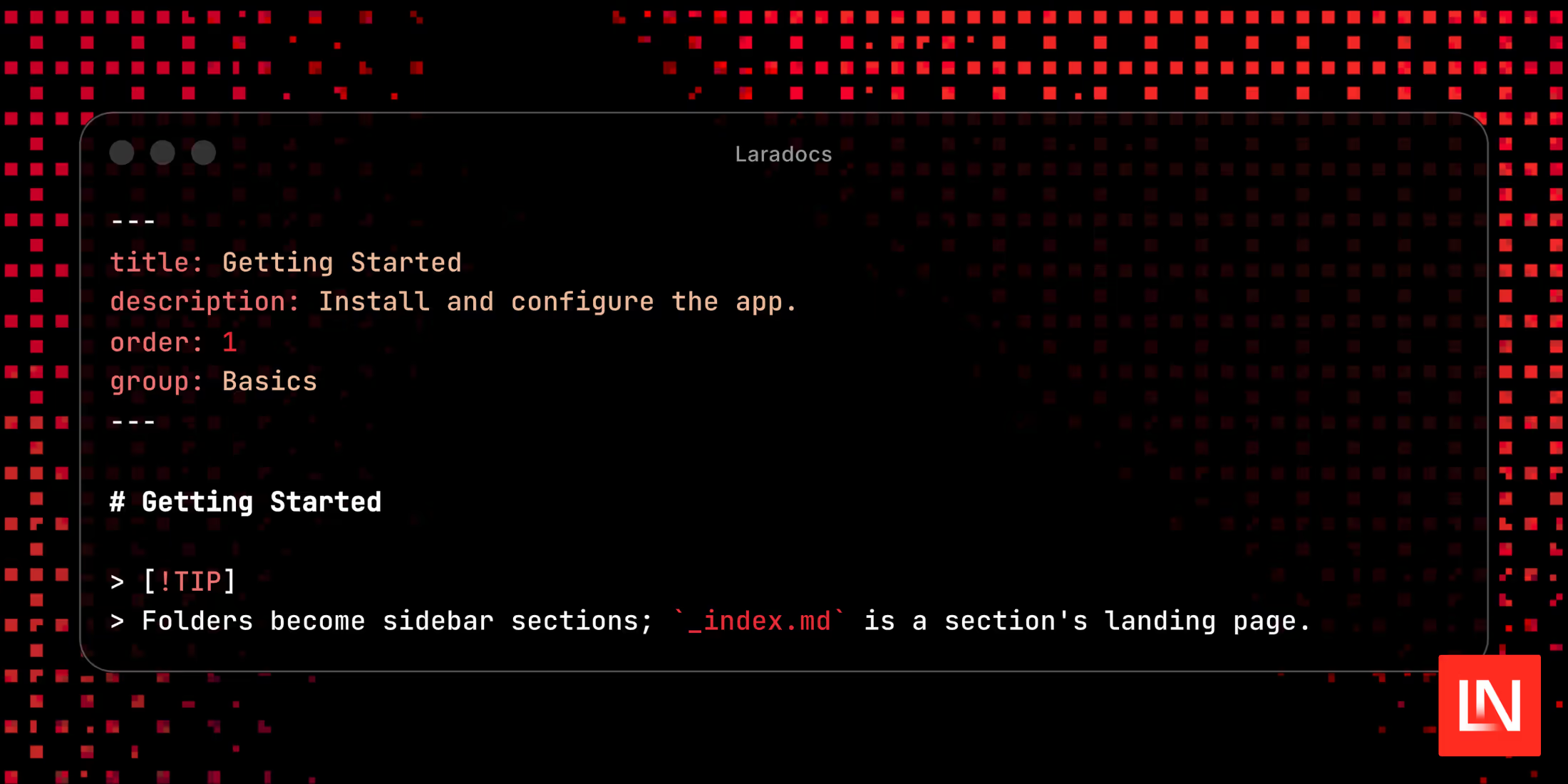
---title: Getting Starteddescription: Install and configure the app.order: 1group: Basics---Supported fields include title, description, order, hidden, group, badge, redirect, tags, and slug. Markdown is processed through CommonMark with GitHub-flavored markdown, tables, and footnotes, plus callout blocks using the familiar GitHub syntax:
> [!TIP]> Folders become sidebar sections; `_index.md` is a section's landing page.Variables and Macros for Reuse
To avoid repeating values across pages, Laradocs lets you register shared variables and reusable macro blocks from a service provider. Variables interpolate into markdown with {{ value }} syntax, and macros render with an @docs() block:
use PeteBishwhip\Laradocs\Facades\Laradocs; Laradocs::variables(fn () => ['version' => '1.0.0']);Laradocs::share('app_name', config('app.name'));Laradocs::macro('tweet', fn (array $args) => "<a href=\"...\">@{$args['user']}</a>");SEO, Caching, and Output
Rendered pages get automatic meta tags, Open Graph and Twitter card data, and JSON-LD, along with a generated sitemap at {prefix}/sitemap.xml. Laradocs caches rendered pages and invalidates the cache when source files change. You can also pre-render every page ahead of time or clear the cache manually:
php artisan laradocs:cachephp artisan laradocs:clearThe package requires PHP 8.2+ and supports Laravel 11, 12, and 13. You can learn more on the Laradocs website and view the source on GitHub.