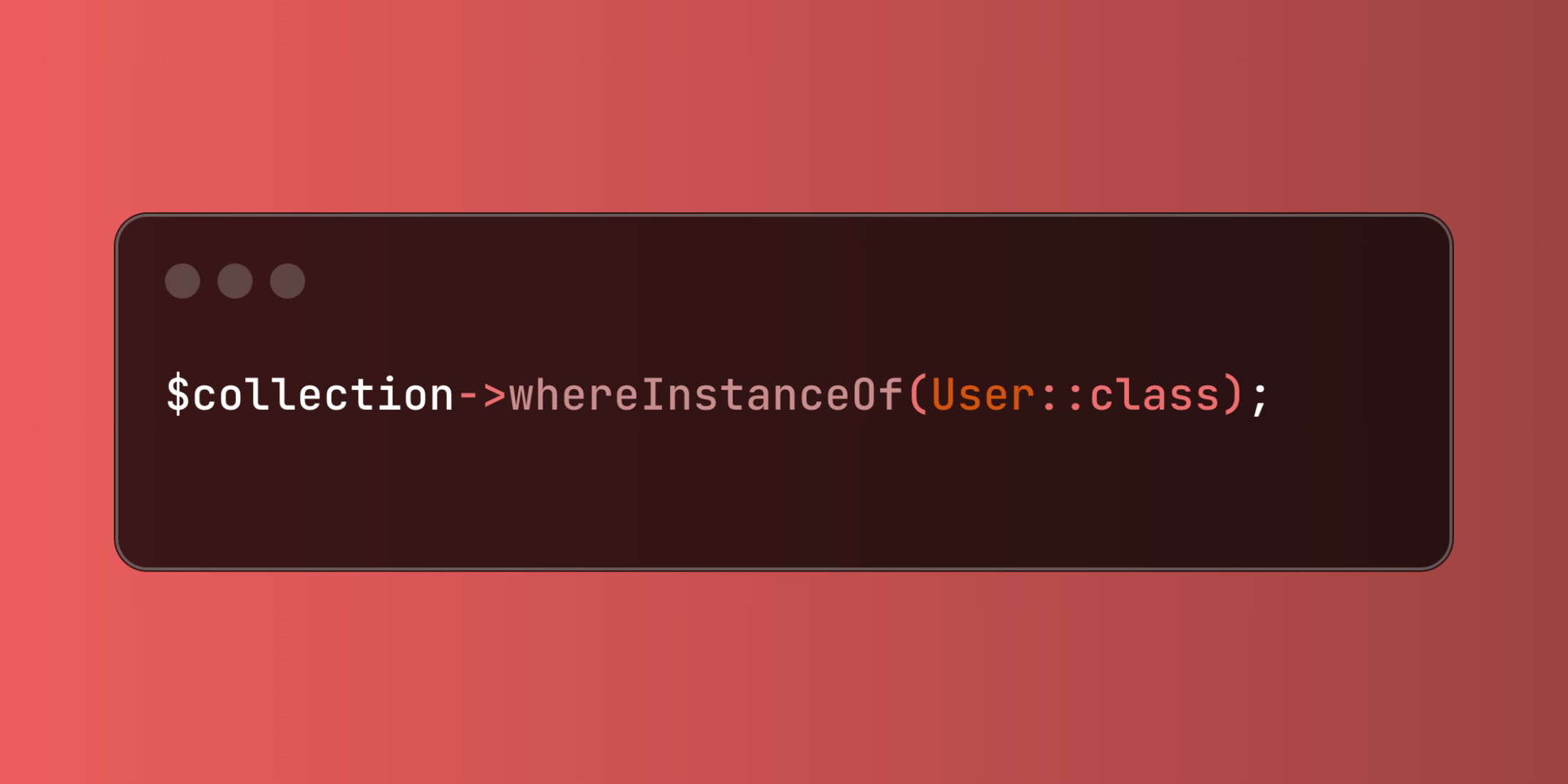
Laravel's whereInstanceOf method provides a clean way to filter collections based on object types, particularly useful when dealing with polymorphic relationships or mixed object collections.
<?php

use App\Models\User;
use App\Models\Post;
use App\Models\Comment;
use Illuminate\Support\Collection;

$collection = collect([
    new User(['name' => 'John']),
    new Post(['title' => 'Hello']),
    new User(['name' => 'Jane']),
]);
$users = $collection->whereInstanceOf(User::class);
Let's explore a practical example of handling a notification feed with different types of activities:
<?php

namespace App\Services;

use App\Models\Comment;
use App\Models\Like;
use App\Models\Follow;
use Illuminate\Support\Collection;

class ActivityFeedService
{
    public function getUserFeed(User $user): array
    {
        // Get all activities
        $activities = collect([
            ...$user->comments()->latest()->limit(5)->get(),
            ...$user->likes()->latest()->limit(5)->get(),
            ...$user->follows()->latest()->limit(5)->get(),
        ]);
        // Sort all activities by created_at
        $activities = $activities->sortByDesc('created_at');

        return [
            'comments' => $activities->whereInstanceOf(Comment::class)
                ->map(fn (Comment $comment) => [
                    'type' => 'comment',
                    'text' => $comment->body,
                    'post_id' => $comment->post_id,
                    'created_at' => $comment->created_at
                ]),
            'likes' => $activities->whereInstanceOf(Like::class)
                ->map(fn (Like $like) => [
                    'type' => 'like',
                    'post_id' => $like->post_id,
                    'created_at' => $like->created_at
                ]),
            'follows' => $activities->whereInstanceOf(Follow::class)
                ->map(fn (Follow $follow) => [
                    'type' => 'follow',
                    'followed_user_id' => $follow->followed_id,
                    'created_at' => $follow->created_at
                ])
        ];
    }
}
WhereInstanceOf simplifies type-based filtering in collections, making it easier to handle mixed object types while maintaining clean, readable code.