Laravel's custom object casting transforms database attributes into rich value objects, enabling sophisticated data handling while maintaining clean model interfaces. This feature bridges the gap between flat database storage and complex application logic.
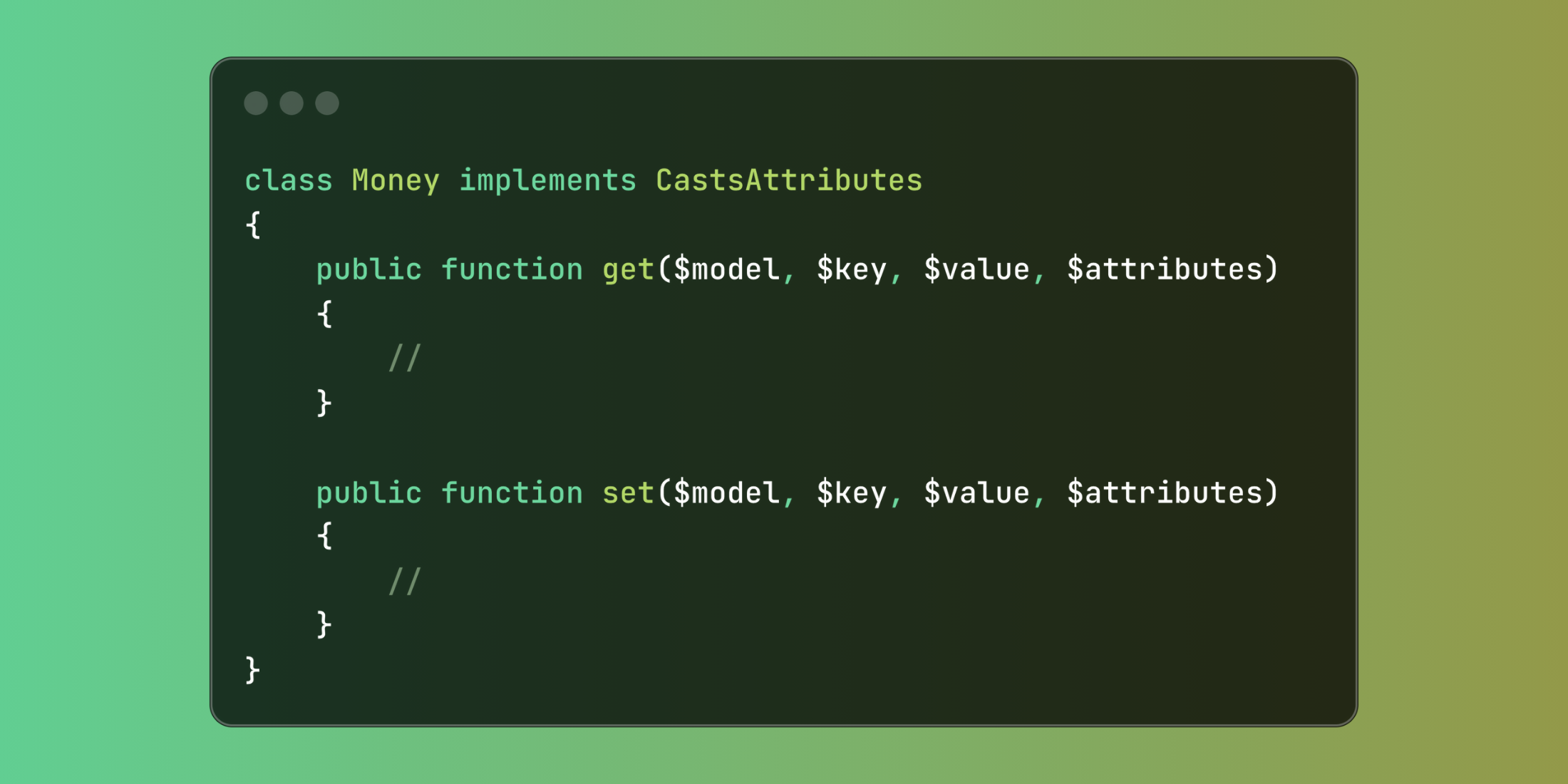
Create custom casts by implementing the CastsAttributes interface:
use Illuminate\Contracts\Database\Eloquent\CastsAttributes;

class Money implements CastsAttributes
{
    public function get($model, $key, $value, $attributes)
    {
        return new MoneyValueObject($value, $attributes['currency'] ?? 'USD');
    }

    public function set($model, $key, $value, $attributes)
    {
        return [
            'amount' => $value->amount,
            'currency' => $value->currency,
        ];
    }
}
Value objects encapsulate related data and behavior, providing a clean interface for complex operations.
class MoneyValueObject implements JsonSerializable
{
    public function __construct(
        public float $amount,
        public string $currency = 'USD'
    ) {}

    public function formatted(): string
    {
        return match($this->currency) {
            'USD' => '$' . number_format($this->amount, 2),
            'EUR' => '€' . number_format($this->amount, 2),
            'GBP' => '£' . number_format($this->amount, 2),
            default => $this->currency . ' ' . number_format($this->amount, 2)
        };
    }

    public function add(MoneyValueObject $other): self
    {
        if ($this->currency !== $other->currency) {
            throw new InvalidArgumentException('Cannot add different currencies');
        }

        return new self($this->amount + $other->amount, $this->currency);
    }

    public function jsonSerialize(): array
    {
        return [
            'amount' => $this->amount,
            'currency' => $this->currency,
            'formatted' => $this->formatted()
        ];
    }
}
Here's a comprehensive invoice system demonstrating advanced custom casting:
class Invoice extends Model
{
    protected $casts = [
        'billing_address' => ContactInfo::class,
        'shipping_address' => ContactInfo::class,
        'total_amount' => Money::class,
        'tax_amount' => Money::class,
        'discount' => Money::class,
    ];

    public function calculateTotal(): MoneyValueObject
    {
        $subtotal = $this->lineItems->sum(fn($item) => $item->total_price->amount);
        $taxTotal = $this->tax_amount->amount;
        $discountTotal = $this->discount->amount;

        return new MoneyValueObject($subtotal + $taxTotal - $discountTotal, $this->total_amount->currency);
    }

    public function lineItems()
    {
        return $this->hasMany(InvoiceLineItem::class);
    }
}

class ContactInfo implements CastsAttributes
{
    public function get($model, $key, $value, $attributes)
    {
        $prefix = $key === 'billing_address' ? 'billing_' : 'shipping_';

        return new ContactInfoValueObject(
            $attributes["{$prefix}name"] ?? '',
            $attributes["{$prefix}company"] ?? '',
            $attributes["{$prefix}address_line_1"] ?? '',
            $attributes["{$prefix}address_line_2"] ?? '',
            $attributes["{$prefix}city"] ?? '',
            $attributes["{$prefix}state"] ?? '',
            $attributes["{$prefix}postal_code"] ?? '',
            $attributes["{$prefix}country"] ?? ''
        );
    }

    public function set($model, $key, $value, $attributes)
    {
        $prefix = $key === 'billing_address' ? 'billing_' : 'shipping_';

        return [
            "{$prefix}name" => $value->name,
            "{$prefix}company" => $value->company,
            "{$prefix}address_line_1" => $value->addressLine1,
            "{$prefix}address_line_2" => $value->addressLine2,
            "{$prefix}city" => $value->city,
            "{$prefix}state" => $value->state,
            "{$prefix}postal_code" => $value->postalCode,
            "{$prefix}country" => $value->country,
        ];
    }
}

class ContactInfoValueObject implements JsonSerializable
{
    public function __construct(
        public string $name,
        public string $company,
        public string $addressLine1,
        public string $addressLine2,
        public string $city,
        public string $state,
        public string $postalCode,
        public string $country
    ) {}

    public function fullAddress(): string
    {
        $parts = array_filter([
            $this->addressLine1,
            $this->addressLine2,
            $this->city,
            $this->state . ' ' . $this->postalCode,
            $this->country
        ]);

        return implode(', ', $parts);
    }

    public function displayName(): string
    {
        return $this->company ? "{$this->name} ({$this->company})" : $this->name;
    }

    public function jsonSerialize(): array
    {
        return get_object_vars($this);
    }
}

class InvoiceController extends Controller
{
    public function store(Request $request)
    {
        $invoice = new Invoice();

        $invoice->billing_address = new ContactInfoValueObject(
            $request->input('billing.name'),
            $request->input('billing.company', ''),
            $request->input('billing.address_line_1'),
            $request->input('billing.address_line_2', ''),
            $request->input('billing.city'),
            $request->input('billing.state'),
            $request->input('billing.postal_code'),
            $request->input('billing.country')
        );

        $invoice->total_amount = new MoneyValueObject(
            $request->input('total'),
            $request->input('currency', 'USD')
        );

        $invoice->save();

        return response()->json([
            'invoice_id' => $invoice->id,
            'formatted_total' => $invoice->total_amount->formatted(),
            'billing_contact' => $invoice->billing_address->displayName()
        ]);
    }

    public function show(Invoice $invoice)
    {
        return view('invoices.show', [
            'invoice' => $invoice,
            'calculatedTotal' => $invoice->calculateTotal()->formatted(),
            'billingDisplay' => $invoice->billing_address->fullAddress()
        ]);
    }
}
Custom object casting enables rich domain modeling while keeping database interactions simple and maintainable throughout your Laravel applications.