It’s hard to believe that we’re already celebrating Filament’s fifth birthday in 2026! In some ways, it feels like just yesterday that Filament v1 released as a basic admin panel package, but in others, it seems practically like ancient history.
We wanted to take a little bit of time and walk down memory lane! For the folks who have been around since the beginning, enjoy the nostalgia with us. For everyone else who is newer to the Filament community, enjoy the glimpse into all of the iterations that led up to what Filament is today!
Filament v1 - The Admin Panel (March 2021)

Filament v1 is where this all began. Launched in March, 2021, Filament was an experiment to see if a better, more ergonomic admin panel could be built with a brand new technology that had rocked the Laravel world: Livewire.
Livewire had released a 1.0 version in early 2020 to a very interested audience, and followed its 1.0 version up with a much-improved 2.0 version in late 2020, with the 2.x improvements carrying on into early 2021.

Livewire promised a reality that, up until that point, wasn’t really possible with other solutions: the ability to write your front-end logic and code in PHP. The goal was simple: why use JavaScript, another language entirely, when PHP could solve many of the same problems? Obviously, JavaScript isn’t entirely replaceable, thus the introduction of Alpine, coupled with the rising popularity of Tailwind CSS, formed a more complete picture–the TALL stack.
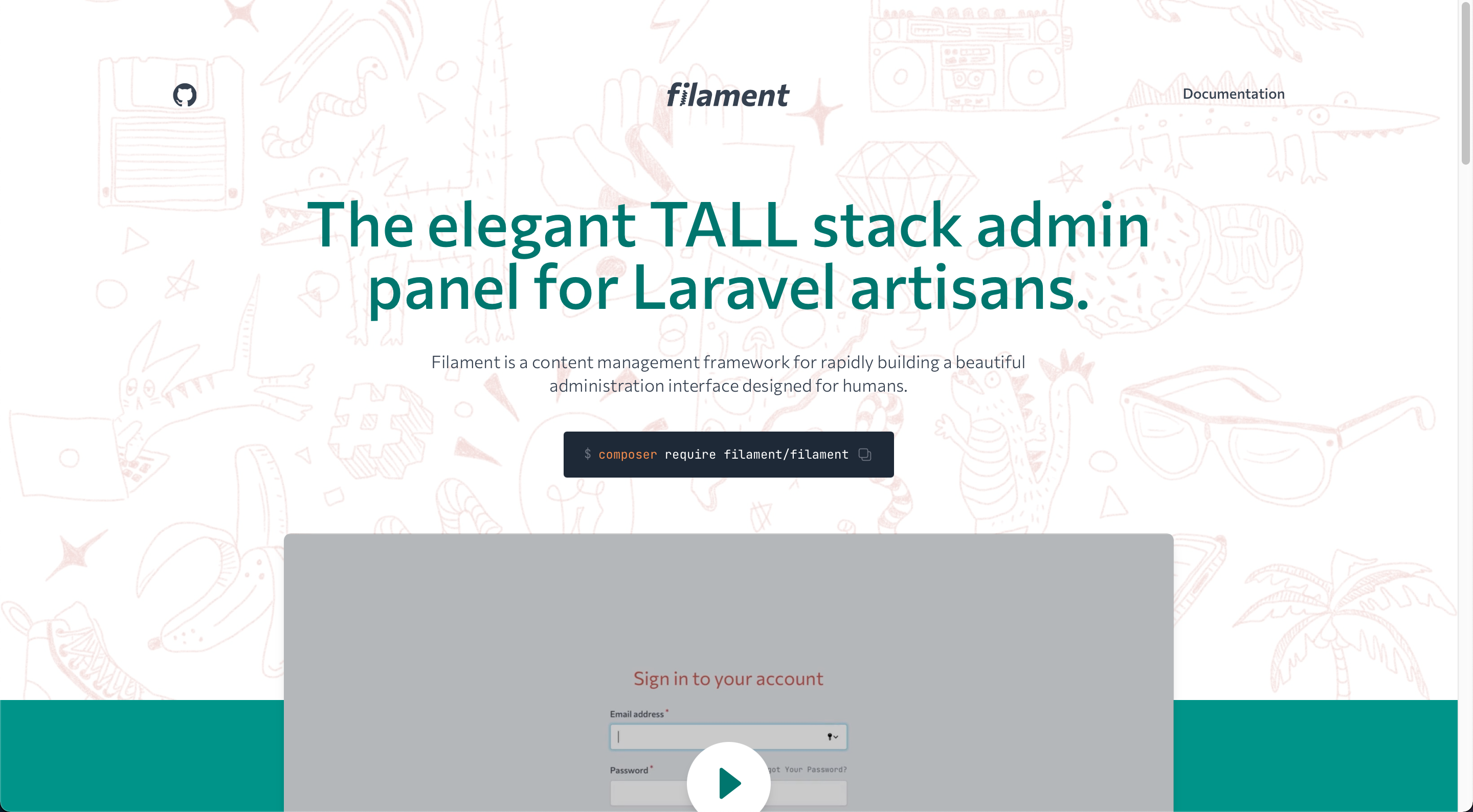
Thus, Filament’s identity was coupled tightly to this new idea of the TALL stack. The question then became “can we build an elegant and useful admin panel for Laravel developers using the TALL stack?”
The answer?
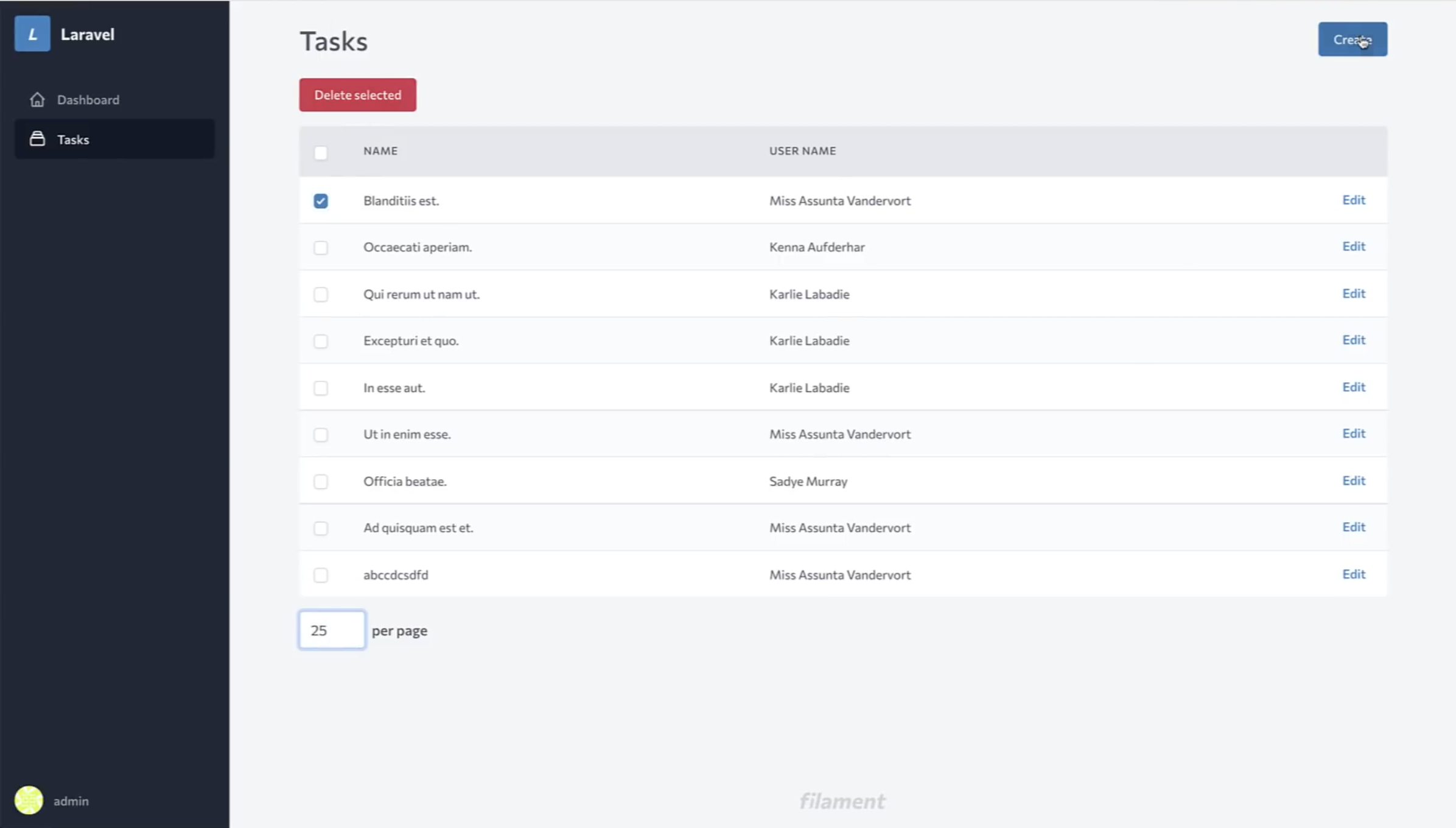
Well, admittedly, it was an admin panel that looked very similar to the other admin panels of the early 2020s! But the looks weren’t what mattered–it was the fact that we had pulled something off that no one else had yet managed to do: build a real, production-ready admin panel system with the TALL stack.
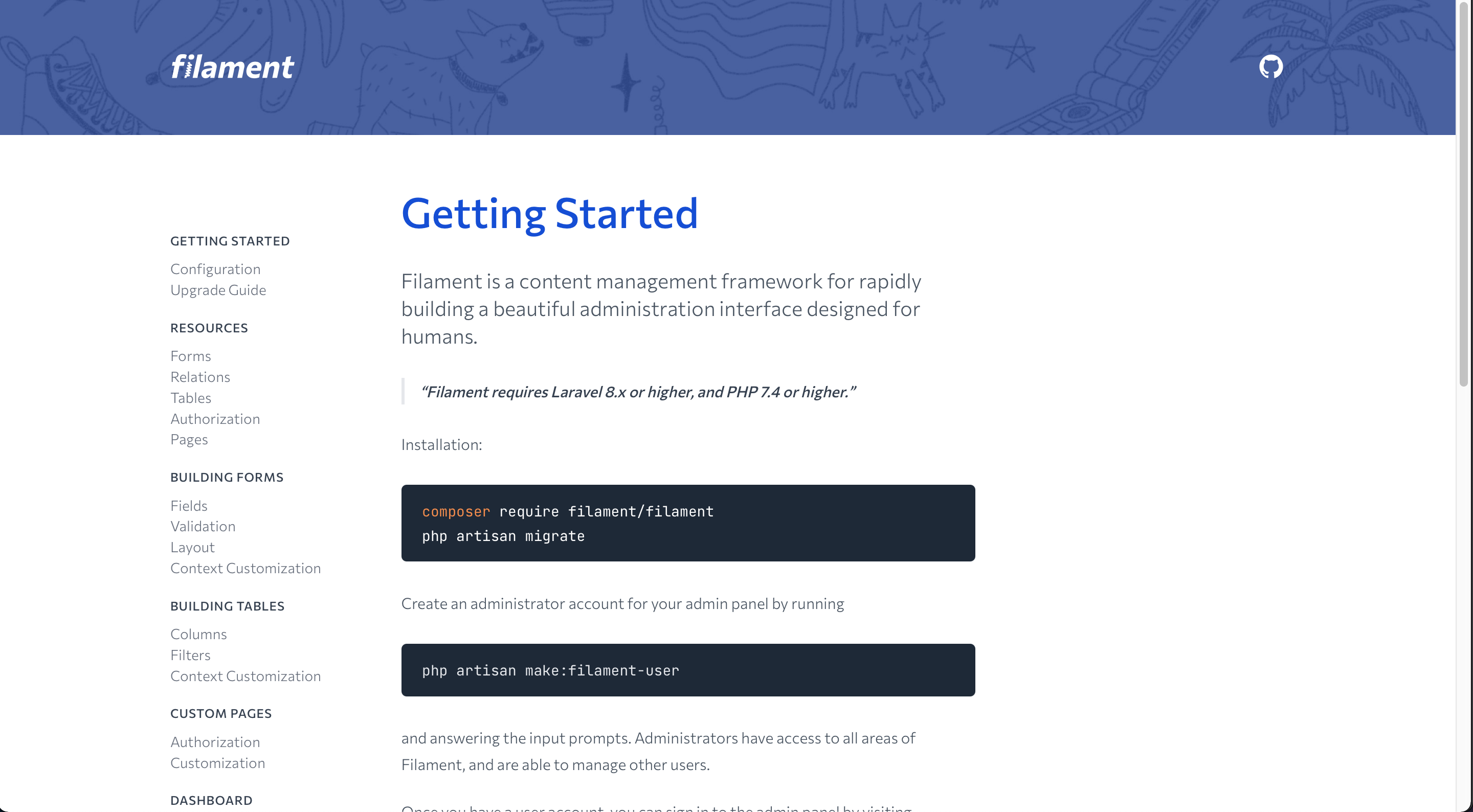
And the fun was just getting started!
Filament v2 - Laying the foundations for Filament (December 2021)
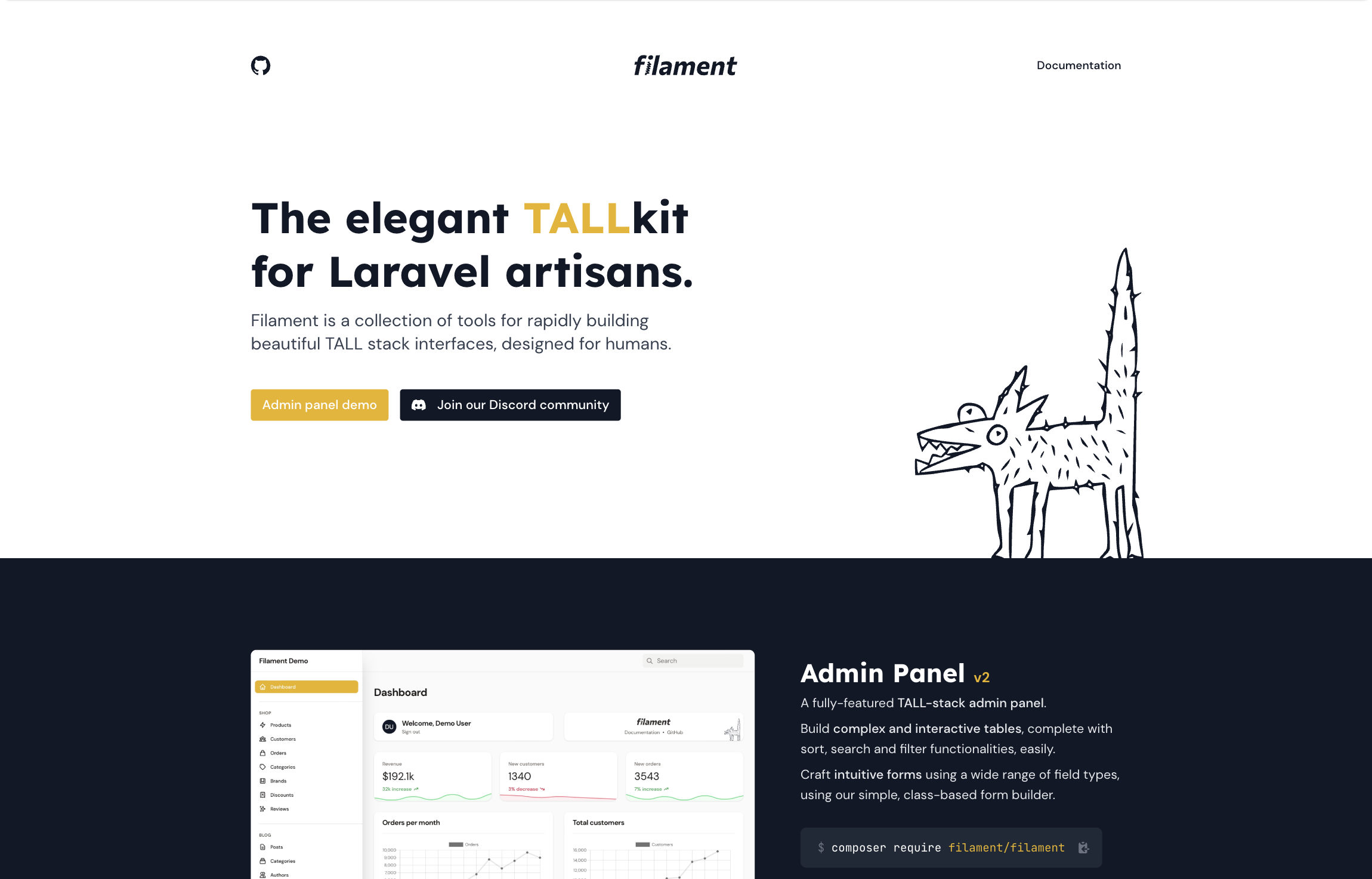
With the proof of concept succeeding with flying colors, the Filament v2 release was a perfect opportunity to take a step back and set ourselves up properly for the future. One of the biggest lessons we took away from v1 was that the admin panel was really, really good. So good, in fact, that we (and others in the community) were anxious to use the UI elements that made up the admin panel, like forms and tables, in their own, non-Filament TALL stack applications.
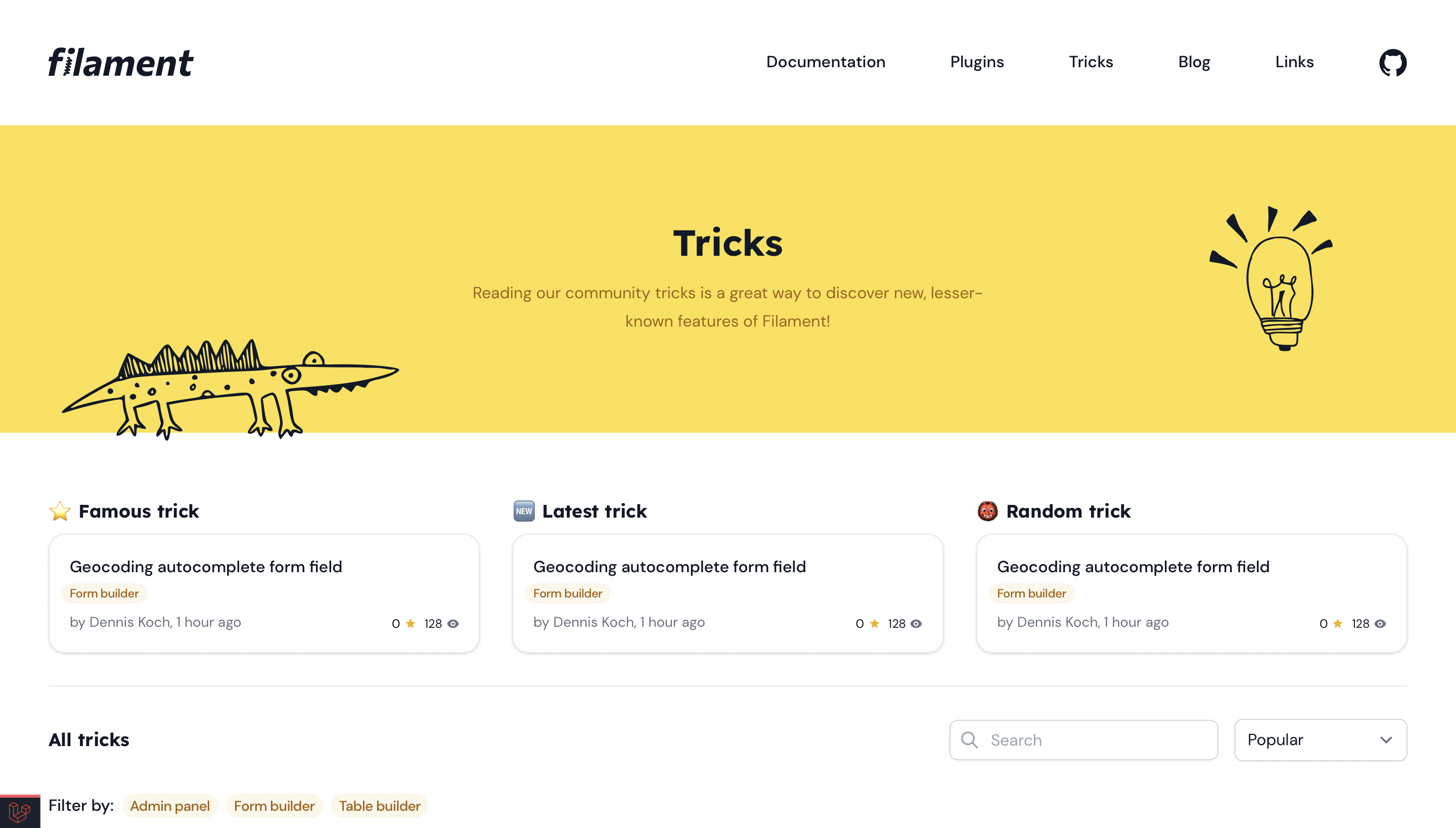
So we set to work splitting the admin panel apart, re-writing major portions of the package to accommodate this new multi-package architecture at the same time. In the end, Filament v2 released with three (soon to be four) individual packages that could be used on their own or combined in any combination: Admin Panel, Forms, Tables, and eventually Notifications. The Forms, Tables, and Notifications packages could be used on their own or in any combination, exactly how our packages work to this day. If you wanted a prebuilt, opinionated combination of these three packages (along with a bunch of other goodies added on top), you could still use the Admin Panel package.
While we were ripping out the old foundations of Filament and replacing them with new, more long-term sustainable pieces, a key feature was implemented that seemed small at the time, but would go on to shape so much about how Filament works. Reactive forms. Until this point, your Filament form fields were not able to natively react to each other. But now, thanks to all of the underlying work done to build v2, reactive forms are a mainstay in Filament.
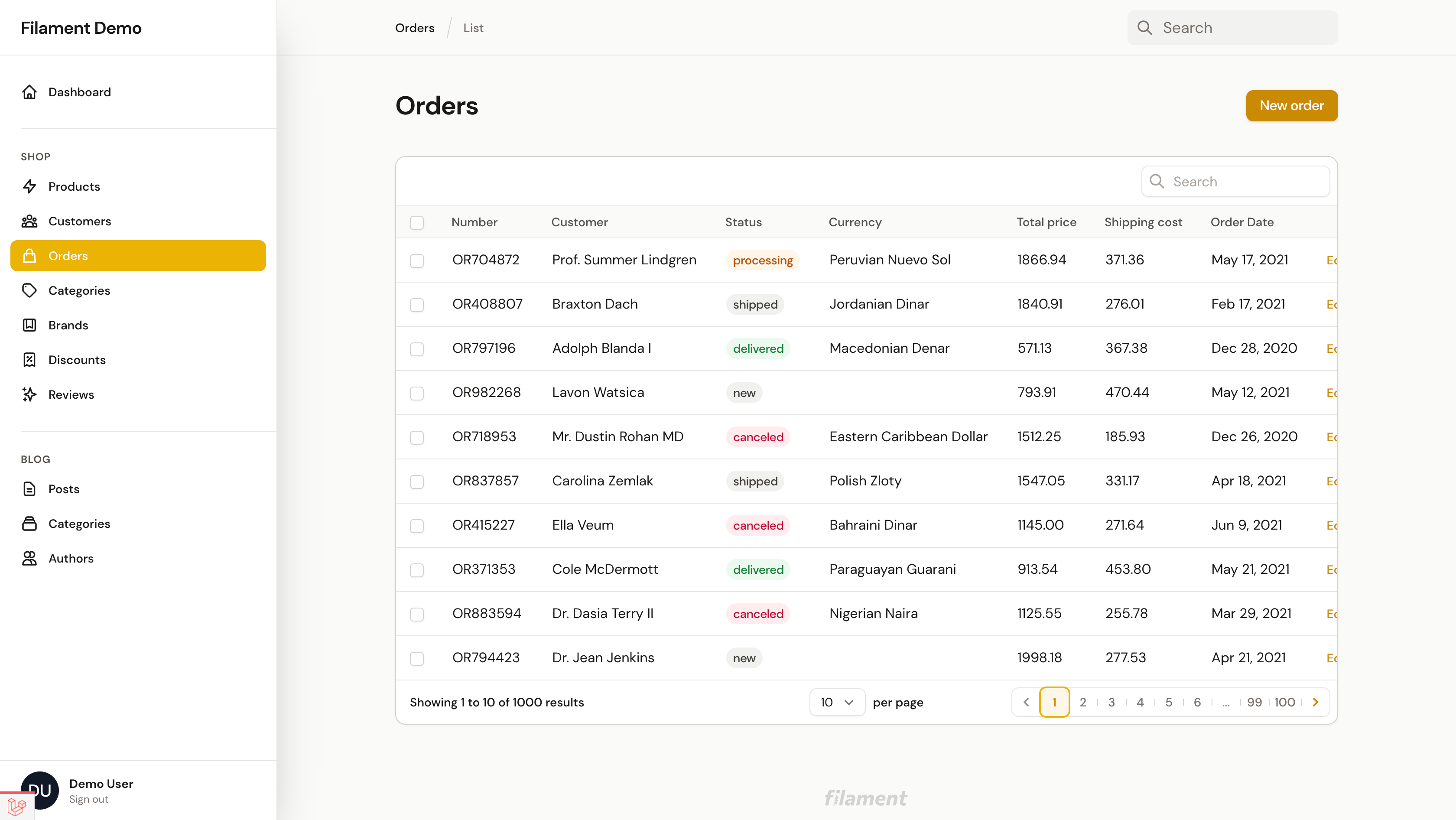
Because we were ripping most everything out and replacing it anyways, it was at this point where Filament’s styling began to shift and shape into the style we know and love today. Along with this new re-theming of Filament, we added another of our most beloved features: dark mode (Barney would have been thrilled)! Even our documentation site got a fresh coat of paint to match the theming updates to the Admin Panel!
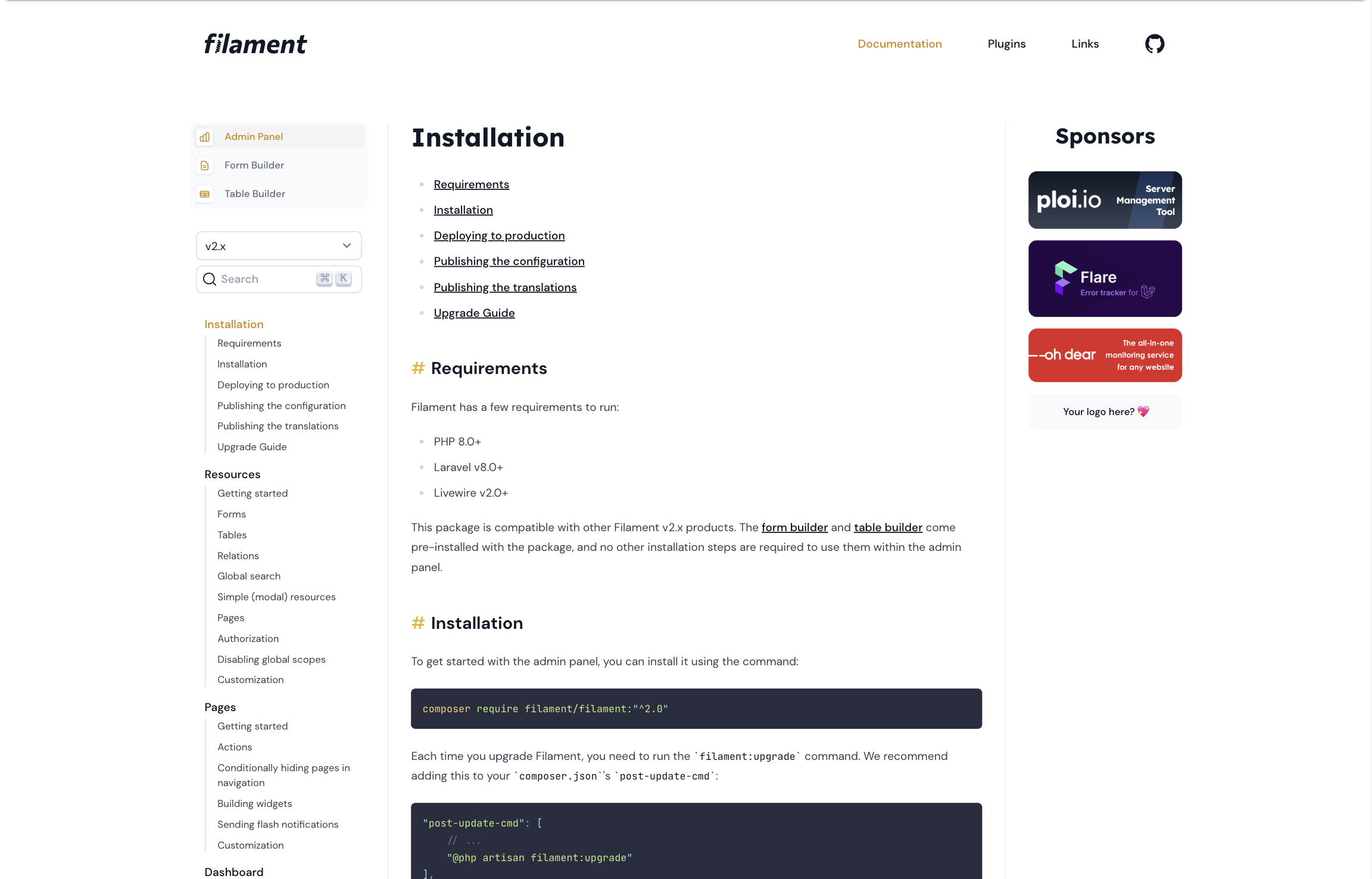
Filament v2 will go down as one of, if not the most important updates in Filament’s development history. There were a bunch of important features added in this version, but most importantly, due to the splitting up of the packages and other foundational work done under the hood, Filament was set on a trajectory that has led us right into the “modern era” of Filament. Because of this, both we as the Filament team and the community as a whole have been able to build incredible, extensible, and shareable creations on top of these strong foundations.
Filament v3 - v5 - Filament’s modern era
Where Filament v1 & v2 were foundational milestones in the project’s history, v3, v4, and most recently, v5, have all been a part of what I have coined as Filament’s “modern era”. These releases have included some incredible re-working of the framework as a whole, but they have primarily been categorized by the massive amount of feature work that was performed in each release.
Filament v3 - Pivoting to panels (August 2023)
Filament v3 contained another large re-work of the underlying Filament systems, including an update to the long-anticipated Livewire v3 and to the Filament design language in both the packages and the marketing site. This design language for the Filament packages still carries through to Filament today, outside of a few tweaks here and there.
In large part, the re-write enabled us to release a few incredibly powerful new features that helped push Filament to be noticed and used by a larger group of people within the Laravel ecosystem.
The first, and most major change that was made was the change of focus with regards to panels. Until this point, Filament was designed and marketed as an “Admin Panel”. You could certainly do other things with it–Filament gave you the tools to build practically whatever you wanted, but in the end, Filament the product and the brand was synonymous with admin panels. In v3, though, this focus changed. We introduced the ability to have multiple panes in your application, and in doing so, we renamed the “Admin Panel” package to just “Panel”. No longer was Filament just for admin panels; it was still unbelievably good at building them, but now you could build your entire application on Filament, no matter how many panels you needed. With the multiple panels came multi-tenancy support as well, a feature that many larger projects had been asking about for quite some time.
In addition to the rewrite of panels, we also introduced a brand new package to our lineup: Infolists. Now the entire trifecta of read and write operations was complete: Forms to create and edit data, tables to view groups of data, and infolists to provide a clean, easy to build read-only interface for single records.
Filament v4 - Leaning into customization (August 2025)
As far as features go, Filament v4 was by far our largest release to date. We wrote an entire blog post about everything new in Filament v4, and then had to write another post about v4.1 because we added almost 40 new features on top of the ones already released in v4!
Our biggest focuses for the v4 launch were not necessarily on the sheer number of features, though that was a nice by-product. Instead, we were heavily focused on improving the overall performance of Filament and unifying concepts across the framework like actions and schemas.
On the performance front, we stripped down every single operation and component in Filament looking for areas where we knew we could save some time, and in the end, we ended up getting a better result than we even thought we were going to. Dan even appeared on one of Nuno’s livestreams and showed off a situation where we had a 3x performance improvement (you can watch the clip here) over Filament v3.
In addition to speeding Filament up dramatically, we also spent some time unifying concepts that, up until this point, lived in multiple different places and ended up tripping many people up. If you used Filament v3, you very likely remember the pain of having to make sure you imported the correct action from the correct package, or else everything would break. Alongside unifying actions, we also merged the underlying component system used to render Forms and Infolists together into “Schemas”, meaning that now supported out of the box, you can put Form fields and infolist entries in the same place in your Filament applications. This alone opened up an incredible amount of functionality–it’s surprising just how often you need plain, read-only data in a form and vice-versa! Need proof? You can look no further than the two-factor authentication UI that comes included with Filament–creating this was drastically simplified when we allowed Forms and Infolists to live alongside each other.
Filament v5 - A new era for Livewire and Filament (January 2026)
In our fastest turnaround for a major version to date, in January of this year, we launched a brand new major version of Filament with exactly no new features.
When we were debating the release date for Filament v4, we knew that, eventually, we would have to bump our major version to allow for our users to upgrade to the newest version of Livewire if Livewire was being manually added into the project for use outside of Filament.
The beauty of a release like this is twofold: first, at the current moment, any changes to v5 that do not require the use of Livewire 4 can be immediately back-ported into Filament v4, increasing the longevity of Filament for folks who are currently unable to upgrade to the latest version of Livewire. Secondly, it allows us to now make use of the new Livewire 4 features going forward without risk of breaking our users’ applications in the process.
In addition to the Livewire changes and not entirely tied to Filament v5, Filament now has a new coat of paint, all thanks to a long branding process that we embarked on throughout 2025. The new style is great, the mascots are amazing, but the best thing to come from all of this is that now, across all of our Filament-related projects, we’ll have one single unifying brand voice.
Oh, and we have new merch. I’m sure that’s realistically the most exciting thing.
What’s next?
I’m sure this is the question on many of your minds, and I don’t blame you (especially with two major releases within almost as many months)! First thing’s first, don’t worry, we have no intention of releasing another major version of Filament in 2026. Obviously, things can change, but for the time being, we’re more than happy to continue working with all of you in the community to improve v5 (and v4).
That said, throughout 2026 we’re going to continue to improve Filament to the best of our abilities and keep shaping it into the best way to build TALL stack applications to date. We’re planning to scale up our content production as well, and we really want to celebrate more with you, the community, so be on the lookout for community events as we go throughout this year!
I’m sure you’re already tired of me saying it, but it’s true: the entire Filament team so greatly appreciates all of the passion and hard work that you all in the community have put into Filament, as well as all of the trust and support that you have given us over the years. As you can see, Filament’s history over the past five years is stuffed full of pivotal moments that have shaped the framework into what it is today, but behind each of those moments was you, the passionate community helping drive positive change forward. So thank you, from the bottom of our hearts, for all the love and support over the past five years, and here’s to many more to come.
- The Filament Team