Building robust Laravel applications often requires validation logic beyond the standard rules. Custom validation rules provide a structured approach to handle complex business requirements while maintaining clean, testable code.
Creating a custom validation rule starts with the Artisan command to generate the rule class structure. This creates a dedicated validation object that implements Laravel's ValidationRule interface:
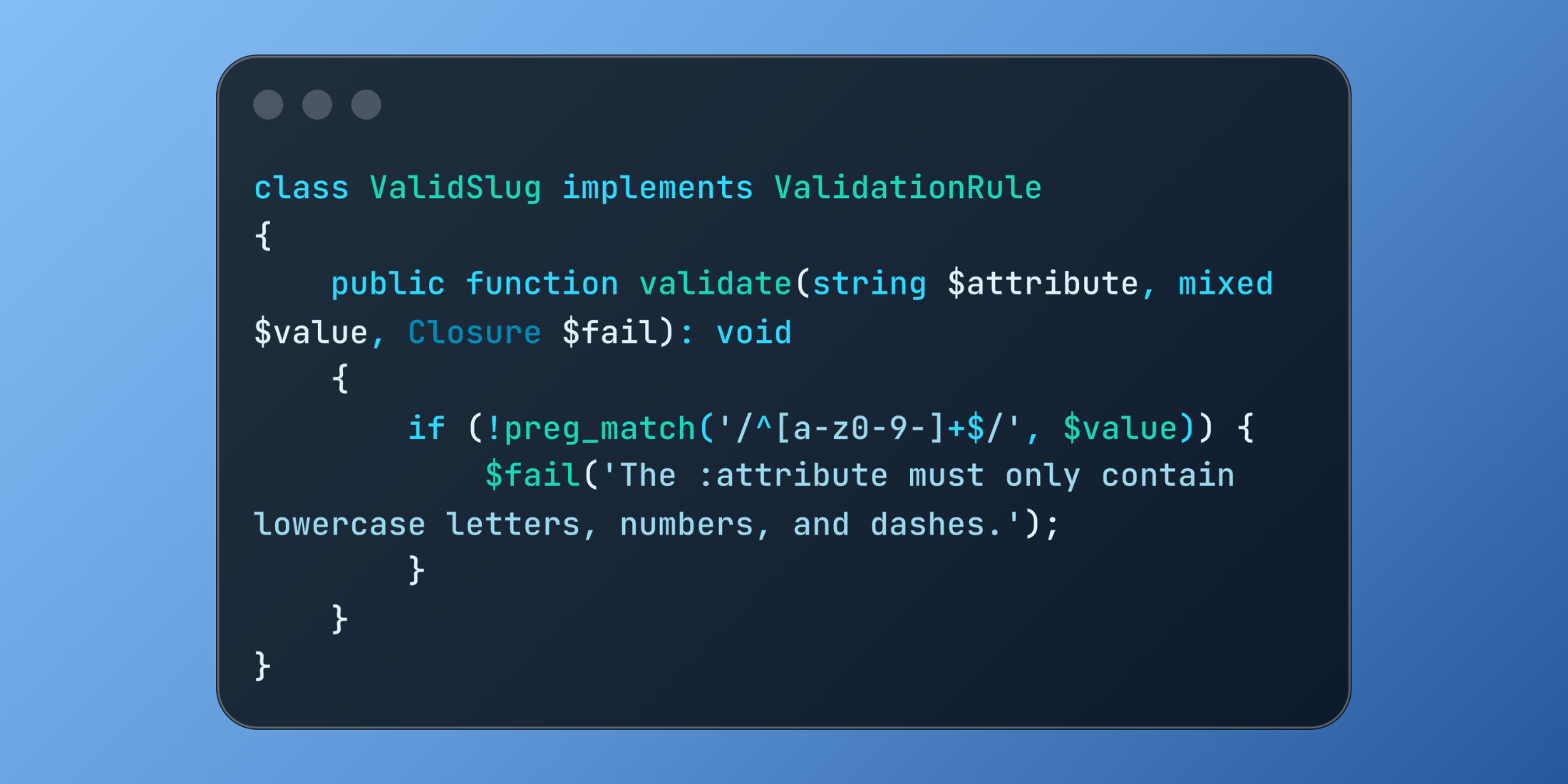
namespace App\Rules; use Closure;use Illuminate\Contracts\Validation\ValidationRule; class ValidSlug implements ValidationRule{ public function validate(string $attribute, mixed $value, Closure $fail): void { if (!preg_match('/^[a-z0-9-]+$/', $value)) { $fail('The :attribute must only contain lowercase letters, numbers, and dashes.'); } }}Applying custom rules follows the same pattern as built-in validation rules. You can integrate them seamlessly into form requests or controller validation:
use App\Rules\ValidSlug; $request->validate([ 'slug' => ['required', new ValidSlug], 'title' => ['required', 'string', 'max:255'],]);Consider a blog system where you need to validate category codes. A simple alphanumeric validator ensures consistent formatting:
namespace App\Rules; use Closure;use Illuminate\Contracts\Validation\ValidationRule; class CategoryCode implements ValidationRule{ public function validate(string $attribute, mixed $value, Closure $fail): void { if (strlen($value) !== 3 || !ctype_alnum($value)) { $fail('The :attribute must be exactly 3 alphanumeric characters.'); } }}$request->validate([ 'name' => ['required', 'string', 'max:100'], 'code' => ['required', new CategoryCode], 'description' => ['nullable', 'string'],]);When validation requires flexibility, you can pass parameters to your custom rules during instantiation:
namespace App\Rules; use Closure;use Illuminate\Contracts\Validation\ValidationRule; class MinimumWordCount implements ValidationRule{ public function __construct(private int $minimumWords) { } public function validate(string $attribute, mixed $value, Closure $fail): void { $wordCount = str_word_count(strip_tags($value)); if ($wordCount < $this->minimumWords) { $fail("The :attribute must contain at least {$this->minimumWords} words."); } }}$request->validate([ 'title' => ['required', 'string', 'max:200'], 'content' => ['required', new MinimumWordCount(50)], 'excerpt' => ['nullable', new MinimumWordCount(10)],]);When validation requires database interaction, custom rules can access Eloquent models and other services. This example ensures email uniqueness within specific organizational boundaries:
namespace App\Rules; use Closure;use App\Models\User;use Illuminate\Contracts\Validation\ValidationRule; class UniqueEmailInDepartment implements ValidationRule{ public function __construct(private int $departmentId) { } public function validate(string $attribute, mixed $value, Closure $fail): void { $exists = User::where('email', $value) ->where('department_id', $this->departmentId) ->exists(); if ($exists) { $fail('This email address is already registered in your department.'); } }}Testing custom validation rules becomes straightforward with dedicated test classes. You can verify both passing and failing scenarios:
class ValidSlugTest extends TestCase{ public function test_accepts_valid_slugs() { $rule = new ValidSlug; $failed = false; $rule->validate('slug', 'my-blog-post', function() use (&$failed) { $failed = true; }); $this->assertFalse($failed); } public function test_rejects_invalid_slugs() { $rule = new ValidSlug; $failed = false; $rule->validate('slug', 'My Blog Post!', function() use (&$failed) { $failed = true; }); $this->assertTrue($failed); }}Custom validation rules transform specific requirements into reusable components that integrate naturally with Laravel's validation system. They promote consistency across your application while keeping validation logic organized and testable. Whether you're handling URL slugs, content requirements, or complex business rules, custom validation provides the flexibility needed for robust applications.