Database transactions serve as a critical safeguard for maintaining data integrity in complex applications. Laravel provides robust transaction capabilities that ensure related database operations execute atomically, guaranteeing that either all changes succeed or none are applied.
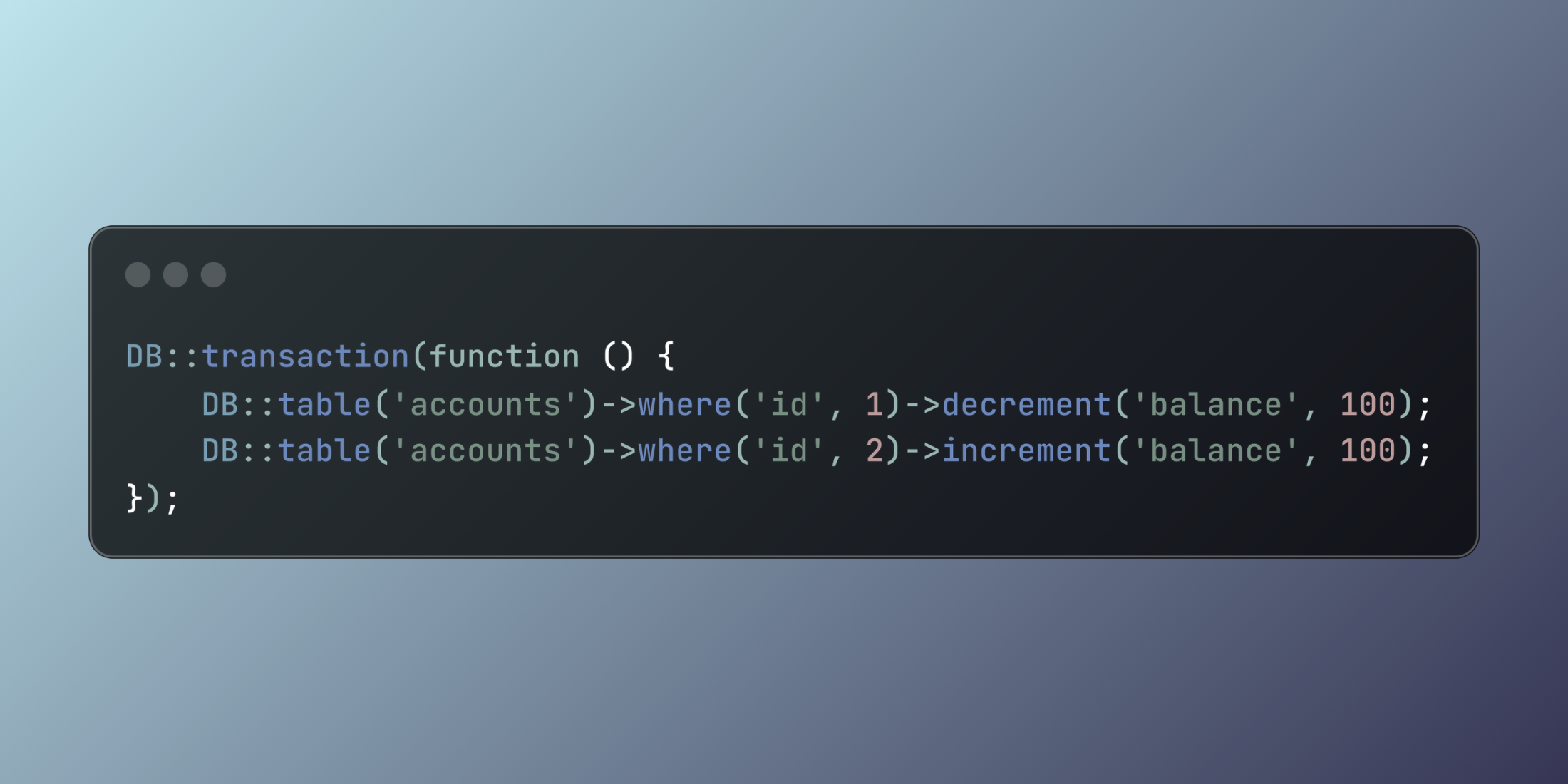
Laravel's DB::transaction method offers the most straightforward approach to transaction handling:
use Illuminate\Support\Facades\DB; DB::transaction(function () { DB::table('accounts')->where('id', 1)->decrement('balance', 100); DB::table('accounts')->where('id', 2)->increment('balance', 100);});This wrapper automatically manages transaction lifecycle, rolling back all changes if any exception occurs within the closure.
Consider a financial application that processes investment portfolio rebalancing operations. Multiple account adjustments must occur simultaneously to maintain accurate financial records:
<?php namespace App\Services; use App\Models\Account;use App\Models\Transaction;use App\Models\Portfolio;use Illuminate\Support\Facades\DB;use Carbon\Carbon; class PortfolioRebalancingService{ public function rebalancePortfolio(Portfolio $portfolio, array $adjustments): bool { return DB::transaction(function () use ($portfolio, $adjustments) { $totalAdjustment = 0; foreach ($adjustments as $adjustment) { $account = Account::findOrFail($adjustment['account_id']); if ($adjustment['amount'] < 0 && $account->balance < abs($adjustment['amount'])) { throw new \Exception("Insufficient funds in account {$account->id}"); } $account->increment('balance', $adjustment['amount']); $totalAdjustment += $adjustment['amount']; Transaction::create([ 'account_id' => $account->id, 'portfolio_id' => $portfolio->id, 'amount' => $adjustment['amount'], 'type' => $adjustment['amount'] > 0 ? 'credit' : 'debit', 'description' => 'Portfolio rebalancing', 'processed_at' => Carbon::now(), ]); } if (abs($totalAdjustment) > 0.01) { throw new \Exception('Transaction amounts must balance to zero'); } $portfolio->update([ 'last_rebalanced_at' => Carbon::now(), 'status' => 'balanced' ]); return true; }, 3); } public function transferFunds(Account $fromAccount, Account $toAccount, float $amount): void { DB::beginTransaction(); try { if ($fromAccount->balance < $amount) { throw new \Exception('Insufficient balance for transfer'); } $fromAccount->decrement('balance', $amount); $toAccount->increment('balance', $amount); Transaction::create([ 'account_id' => $fromAccount->id, 'amount' => -$amount, 'type' => 'transfer_out', 'reference_account_id' => $toAccount->id, 'processed_at' => Carbon::now(), ]); Transaction::create([ 'account_id' => $toAccount->id, 'amount' => $amount, 'type' => 'transfer_in', 'reference_account_id' => $fromAccount->id, 'processed_at' => Carbon::now(), ]); DB::commit(); } catch (\Exception $e) { DB::rollBack(); throw $e; } } public function batchUpdateHoldings(Portfolio $portfolio, array $holdings): void { DB::transaction(function () use ($portfolio, $holdings) { $portfolio->holdings()->delete(); foreach ($holdings as $holding) { $portfolio->holdings()->create([ 'symbol' => $holding['symbol'], 'quantity' => $holding['quantity'], 'average_cost' => $holding['average_cost'], 'current_value' => $holding['current_value'], ]); } $totalValue = collect($holdings)->sum('current_value'); $portfolio->update(['total_value' => $totalValue]); }); }} class SubscriptionManager{ public function upgradePlan(User $user, Plan $newPlan): void { DB::transaction(function () use ($user, $newPlan) { $currentSubscription = $user->subscription; if ($currentSubscription) { $remainingDays = $currentSubscription->ends_at->diffInDays(Carbon::now()); $creditAmount = ($currentSubscription->plan->price / 30) * $remainingDays; $user->account->increment('credit_balance', $creditAmount); $currentSubscription->update(['status' => 'cancelled']); } $user->subscriptions()->create([ 'plan_id' => $newPlan->id, 'starts_at' => Carbon::now(), 'ends_at' => Carbon::now()->addMonth(), 'status' => 'active' ]); $user->account->decrement('credit_balance', $newPlan->price); if ($user->account->credit_balance < 0) { throw new \Exception('Insufficient account balance'); } }); }}Laravel supports transaction retry mechanisms for handling deadlocks, and provides isolation level control for advanced scenarios. The framework also integrates transaction handling with Eloquent models, allowing you to call User::transaction() directly on model classes for more semantic operations.