String validation in Laravel applications frequently involves checking what content should NOT match certain patterns. Laravel's new inverse string methods eliminate awkward negation logic, creating more intuitive and maintainable validation code.
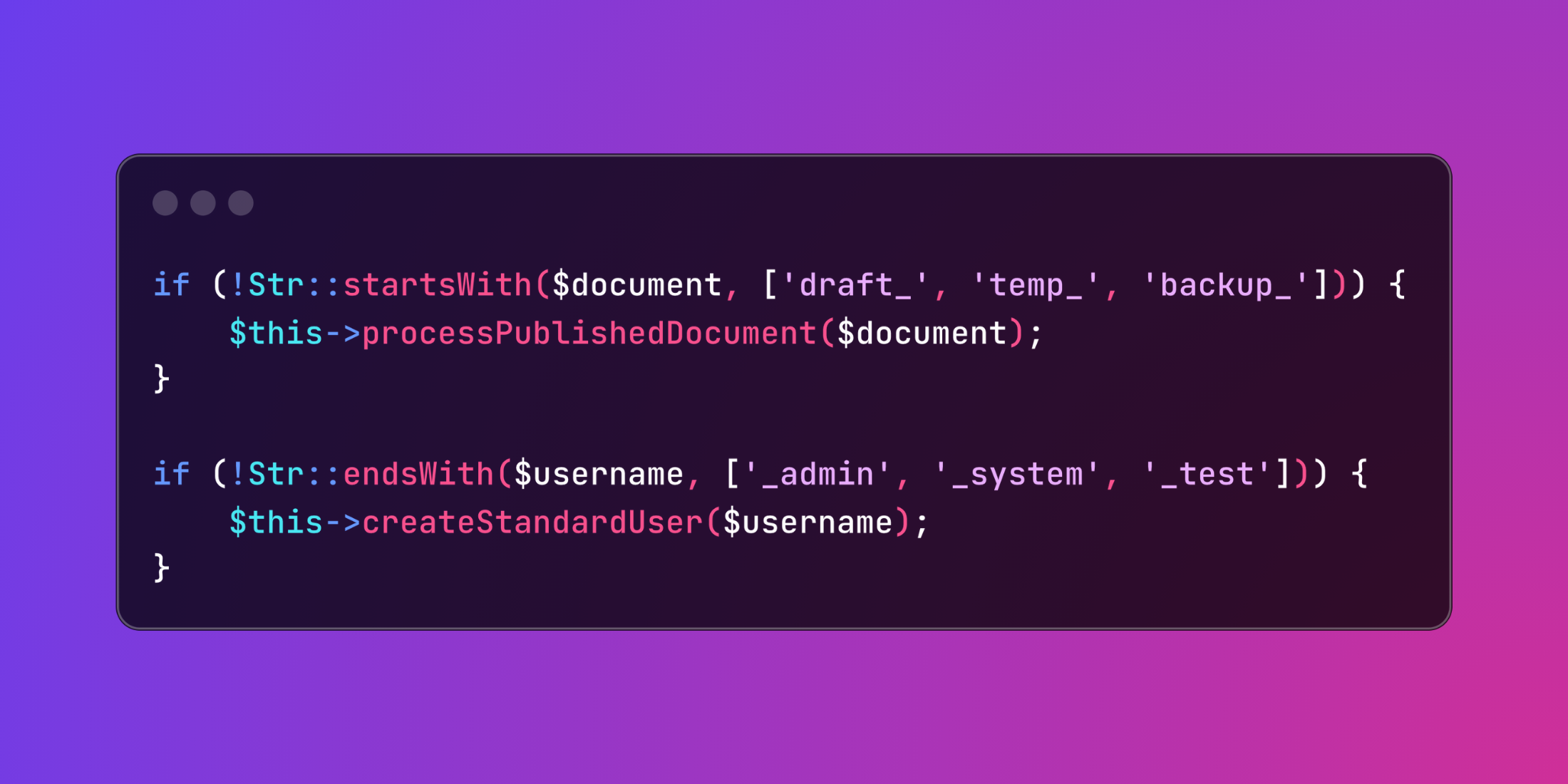
Moving Beyond Double Negatives Traditional string validation often required negating existing methods, creating mental overhead when reading conditions:
use Illuminate\Support\Str; if (!Str::startsWith($document, ['draft_', 'temp_', 'backup_'])) { $this->processPublishedDocument($document);} if (!Str::endsWith($username, ['_admin', '_system', '_test'])) { $this->createStandardUser($username);}Laravel's inverse methods transform these conditions into clear, positive statements:
if (Str::doesntStartWith($document, ['draft_', 'temp_', 'backup_'])) { $this->processPublishedDocument($document);} if (Str::doesntEndWith($username, ['_admin', '_system', '_test'])) { $this->createStandardUser($username);}Both methods accept single strings or arrays, maintaining the same flexibility as their counterparts while improving code readability.
Here's a content management system that demonstrates these methods in practical validation scenarios:
class ContentValidationService{ private array $draftPrefixes = ['draft_', 'wip_', 'preview_']; private array $systemSuffixes = ['_config', '_admin', '_internal']; private array $reservedWords = ['system', 'admin', 'root', 'api']; private array $unsafeTags = ['<script>', '<iframe>', '<embed>']; public function validateSlugCreation(string $title): array { $slug = Str::slug($title); $errors = []; if (Str::doesntStartWith($slug, $this->reservedWords)) { // Safe slug prefix } else { $errors[] = 'Slug cannot start with reserved words'; } if (Str::doesntEndWith($slug, $this->systemSuffixes)) { // Valid ending pattern } else { $errors[] = 'Slug cannot end with system suffixes'; } return [ 'valid' => empty($errors), 'slug' => $slug, 'errors' => $errors ]; } public function sanitizeContentInput(string $content): array { $maliciousPatterns = ['<script', 'javascript:', 'data:image']; $suspiciousEndings = ['.exe"', '.bat"', '.cmd"']; $validation = [ 'safe_opening' => Str::doesntStartWith( Str::lower($content), array_map('strtolower', $maliciousPatterns) ), 'safe_references' => Str::doesntEndWith( Str::lower($content), $suspiciousEndings ), 'content_length' => strlen($content) ]; return array_merge($validation, [ 'is_safe' => $validation['safe_opening'] && $validation['safe_references'] ]); } public function categorizeUserFiles(array $filePaths): array { $categories = [ 'published' => [], 'drafts' => [], 'user_content' => [], 'restricted' => [] ]; foreach ($filePaths as $path) { $filename = basename($path); if (Str::doesntStartWith($filename, $this->draftPrefixes)) { if (Str::doesntEndWith($filename, $this->systemSuffixes)) { $categories['published'][] = $path; } else { $categories['restricted'][] = $path; } } else { $categories['drafts'][] = $path; } } return $categories; } public function validateApiEndpoint(string $endpoint): bool { $restrictedPrefixes = ['/admin/', '/system/', '/internal/']; $restrictedSuffixes = ['/delete', '/purge', '/reset']; return Str::doesntStartWith($endpoint, $restrictedPrefixes) && Str::doesntEndWith($endpoint, $restrictedSuffixes); }} class PostController extends Controller{ public function __construct( private ContentValidationService $validator ) {} public function store(Request $request) { $title = $request->input('title'); $content = $request->input('content'); $slugValidation = $this->validator->validateSlugCreation($title); $contentValidation = $this->validator->sanitizeContentInput($content); if (!$slugValidation['valid'] || !$contentValidation['is_safe']) { return back()->withErrors([ 'title' => $slugValidation['errors'] ?? [], 'content' => $contentValidation['is_safe'] ? [] : ['Content contains unsafe patterns'] ]); } Post::create([ 'title' => $title, 'slug' => $slugValidation['slug'], 'content' => $content, 'status' => 'published' ]); return redirect()->route('posts.index') ->with('success', 'Post created successfully'); }}The inverse methods create self-documenting code where conditions read naturally: "if this doesn't start with draft prefixes" rather than "if not starts with draft prefixes." This improvement becomes especially valuable in complex validation chains where multiple conditions combine.
These methods integrate seamlessly with Laravel's fluent string API, enabling elegant method chaining:
$isValid = str($filename) ->lower() ->doesntStartWith(['temp_', 'cache_']) ->doesntEndWith(['.tmp', '.bak']);Laravel's inverse string methods transform validation logic from mentally taxing double negatives into clear, expressive conditions that improve code maintainability and developer comprehension.