Laravel's HTTP Client now includes a resource() method that streamlines working with response streams, eliminating the verbose setup previously required for stream operations.
Before this enhancement, converting HTTP responses to streams required multiple steps and additional imports:
$response = Http::get($documentUrl);$stream = StreamWrapper::getResource($response->toPsrResponse()->getBody());Storage::writeStream('document.pdf', $stream);The new approach reduces this to a single method call, making stream handling more intuitive and readable.
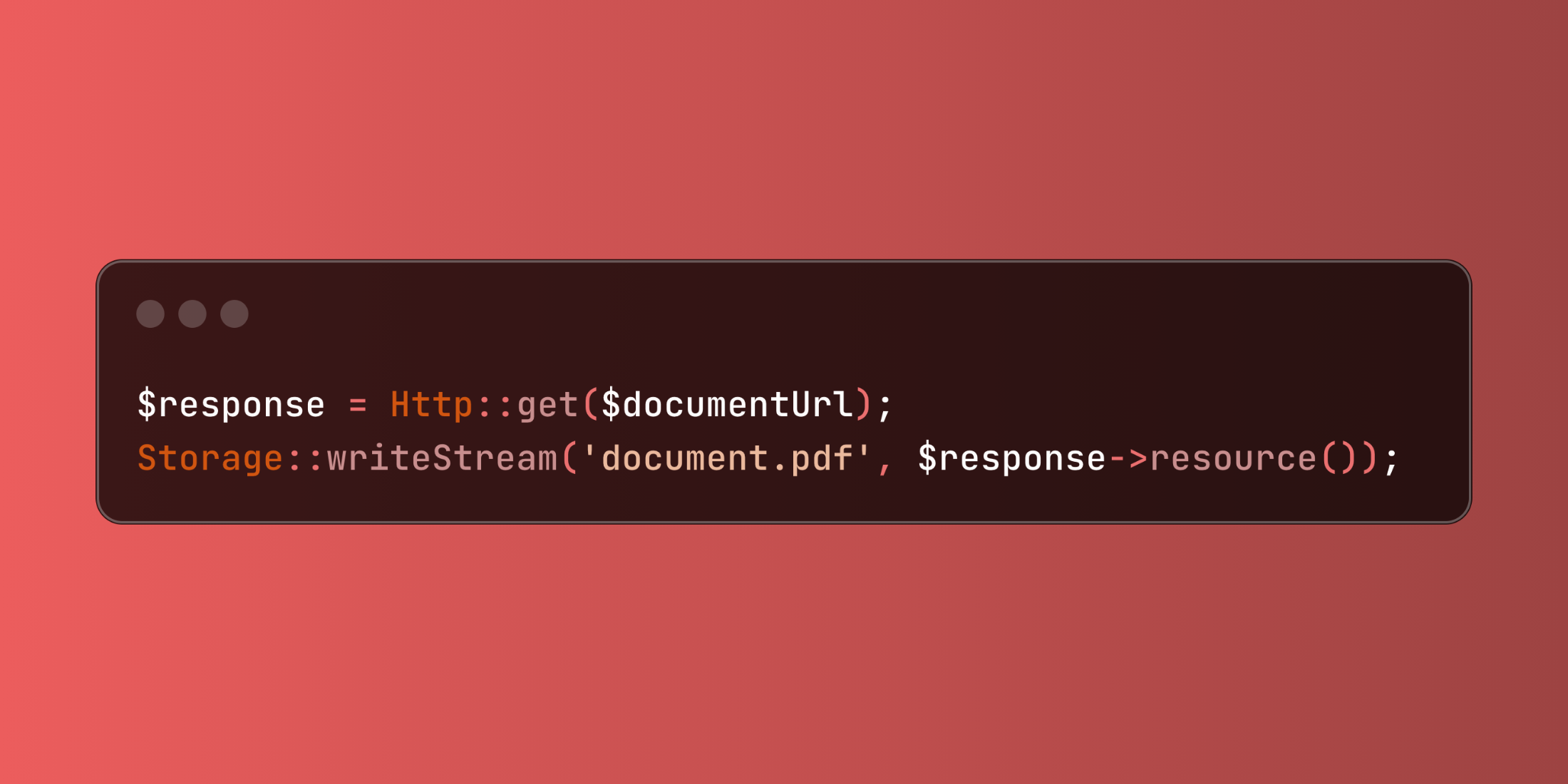
$response = Http::get($documentUrl);Storage::writeStream('document.pdf', $response->resource());Here's a file backup service that demonstrates practical stream usage:
class BackupService{ public function downloadRemoteBackup(string $backupUrl, string $destinationPath) { try { $this->validateBackupUrl($backupUrl); $response = Http::timeout(300)->get($backupUrl); if ($response->failed()) { throw new BackupDownloadException("Failed to retrieve backup from {$backupUrl}"); } $fileSize = $response->header('Content-Length'); $this->logBackupStart($backupUrl, $fileSize); Storage::disk('backups')->writeStream( $destinationPath, $response->resource() ); $this->verifyBackupIntegrity($destinationPath, $fileSize); $this->logBackupCompletion($destinationPath); return true; } catch (Exception $e) { $this->logBackupError($backupUrl, $e->getMessage()); throw new BackupProcessingException("Backup operation failed: {$e->getMessage()}"); } } public function syncMediaLibrary(array $mediaUrls) { $results = []; foreach ($mediaUrls as $url) { $filename = basename(parse_url($url, PHP_URL_PATH)); try { $response = Http::get($url); if ($response->successful()) { Storage::disk('media')->writeStream( "library/{$filename}", $response->resource() ); $results[$url] = 'success'; } else { $results[$url] = 'failed'; } } catch (Exception $e) { $results[$url] = 'error: ' . $e->getMessage(); } } return $results; } private function validateBackupUrl(string $url) { if (!filter_var($url, FILTER_VALIDATE_URL)) { throw new InvalidArgumentException("Invalid backup URL provided"); } } private function verifyBackupIntegrity(string $path, $expectedSize) { $actualSize = Storage::disk('backups')->size($path); if ($expectedSize && $actualSize !== (int) $expectedSize) { throw new BackupIntegrityException("File size mismatch during backup verification"); } }}The resource() method simplifies file operations and reduces boilerplate code when working with HTTP response streams in Laravel applications.