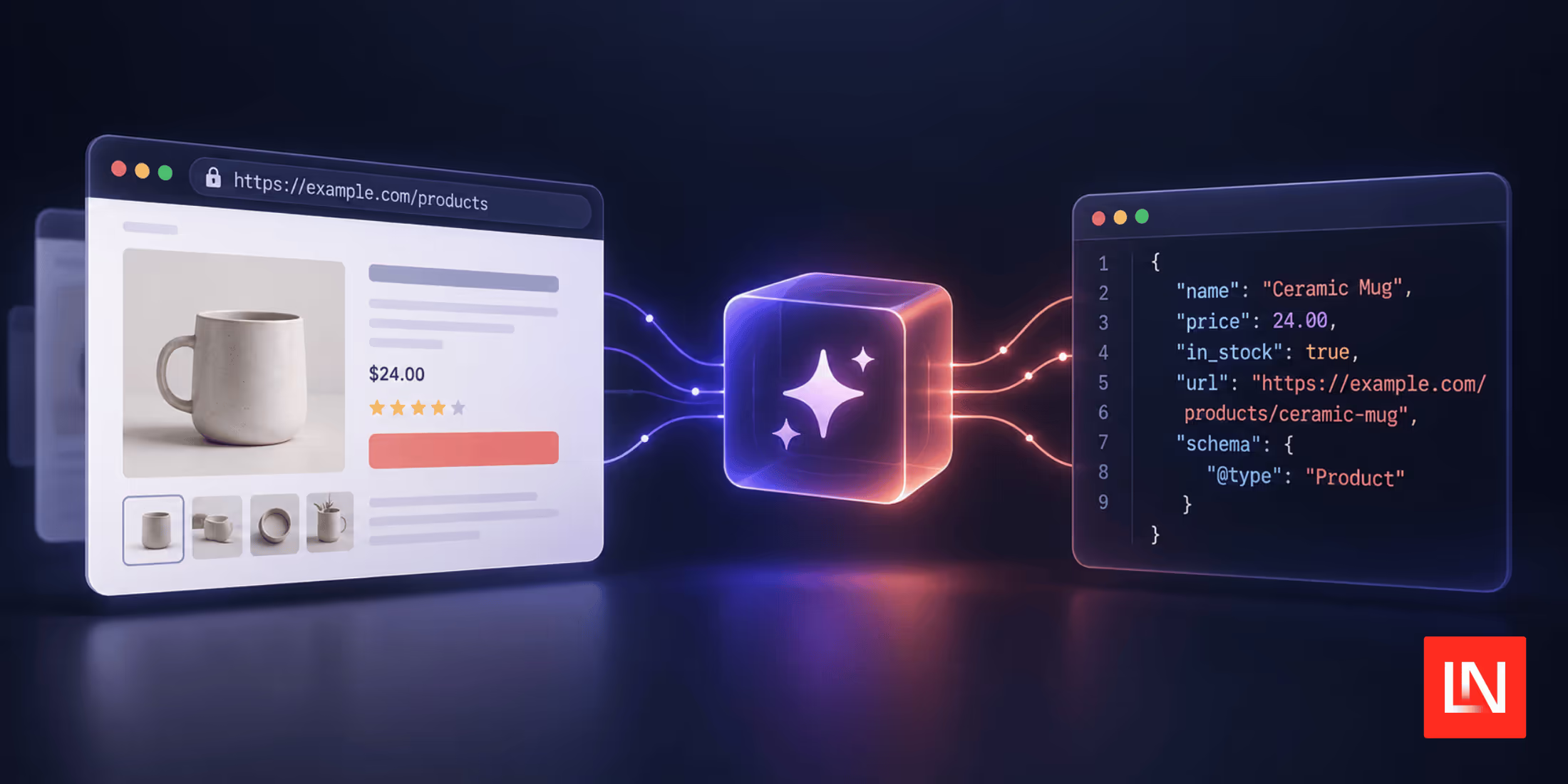
Spatie's Laravel URL AI Transformer fetches a list of URLs, sends each page's content to an AI model, and stores the response in your database. You might use it to generate JSON-LD for your own pages, or to pull product details out of a page into fields your app can query. Version 2 of this package builds every transformer as a Laravel AI agent.
The package also includes:
- A built-in
LdJsonTransformer: it asks the model for schema.org JSON-LD and validates the JSON before it is stored - Command filters:
transform-urls --url="*/blog/*"and--transformer="ldJson"accept wildcards, so you can rerun part of a site - Conditional runs: a transformer can define
shouldRun()to skip URLs it processed recently, and--forceignores it - Failure tracking: the exception message and trace are stored on the result row, and a
TransformerFailedevent fires - Regeneration:
regenerate()queues a single result again, andregenerateNow()runs it synchronously - Crawling: pair it with spatie/crawler to transform every internal URL on a site
- Transformers without AI: override
transform()to compute a result yourself, such as a word count
Registering URLs
You register URLs and the transformers to run on them with the Transform class, typically in a service provider:
use Spatie\LaravelUrlAiTransformer\Support\Transform;use Spatie\LaravelUrlAiTransformer\Transformers\LdJsonTransformer; Transform::urls( 'https://example.com/about', 'https://example.com/products',)->usingTransformers(new LdJsonTransformer, new SummaryTransformer);The urls() method also accepts a closure. It only runs when the transformation does, so loading URLs from the database doesn't add a query to every request:
Transform::urls( fn () => Article::published()->pluck('url')->toArray())->usingTransformers(new LdJsonTransformer);The transform-urls Artisan command fetches each URL once and dispatches a queued job for every transformer registered on it. You'll need a queue worker running, or you can pass --now to run everything synchronously. Results are stored in the transformation_results table, and you read them back by URL and transformer type:
use Spatie\LaravelUrlAiTransformer\Models\TransformationResult; $ldJson = TransformationResult::forUrl('https://example.com/about', 'ldJson');The type defaults to the camel-cased class name without the Transformer suffix, and you can pass the class name instead. Schedule the command in routes/console.php to keep results current.
Writing a Transformer
Run php artisan make:transformer SummaryTransformer to generate a class in app/Transformers. A transformer only needs an instructions() method, which becomes the agent's system prompt. The package sends the page content along as the user prompt:
namespace App\Transformers; use Spatie\LaravelUrlAiTransformer\Transformers\Transformer;use Stringable; class SummaryTransformer extends Transformer{ public function instructions(): Stringable|string { return 'Summarize this webpage content in 3 concise bullet points.'; }}Before the content is sent, the package strips scripts, styles, and HTML tags, collapses whitespace, and cuts the text at 6,000 characters. You can override content() on a single transformer to send something different, or swap the PrepareUrlContentAction in the config to change it for every transformer.
Structured Output
A transformer that implements Laravel AI's HasStructuredOutput contract returns data validated against a schema, which the package stores as JSON:
use Illuminate\Contracts\JsonSchema\JsonSchema;use Laravel\Ai\Contracts\HasStructuredOutput;use Spatie\LaravelUrlAiTransformer\Transformers\Transformer;use Stringable; class ProductTransformer extends Transformer implements HasStructuredOutput{ public function instructions(): Stringable|string { return 'Extract the product details from this webpage.'; } public function schema(JsonSchema $schema): array { return [ 'name' => $schema->string()->required(), 'price' => $schema->number()->required(), 'in_stock' => $schema->boolean(), ]; }}For data with an open shape, such as JSON-LD, the docs describe a schema with a single required json string property. You then decode that string in resultFrom() with JSON_THROW_ON_ERROR. Invalid JSON throws, marks the transformation as failed, and lets the queued job retry. The built-in LdJsonTransformer works this way. Laravel News has a longer walkthrough of schemas in Laravel AI, using ticket triage with structured output.
Choosing a Provider and Model
The config file sets a default provider from Laravel AI's Lab enum and a default model. The model can be a model name, Model::Cheapest, or Model::Smartest, and it defaults to the cheapest model on OpenAI. Individual transformers override this with Laravel AI attributes:
use Laravel\Ai\Attributes\MaxTokens;use Laravel\Ai\Attributes\Model;use Laravel\Ai\Attributes\Provider;use Laravel\Ai\Attributes\Temperature;use Laravel\Ai\Enums\Lab;use Spatie\LaravelUrlAiTransformer\Transformers\Transformer;use Stringable; #[Provider(Lab::Anthropic)]#[Model('claude-haiku-4-5-20251001')]#[MaxTokens(1000)]#[Temperature(0.1)]class FactsTransformer extends Transformer{ public function instructions(): Stringable|string { return 'Extract the key facts as accurately as possible.'; }}You can also use #[UseSmartestModel] to keep the configured provider and change only the model. When the choice depends on runtime data, define provider() and model() methods instead.
Testing Transformers
To test a transformer, fake the page with Laravel's Http facade and the AI response with fake() on the transformer class:
it('generates summaries for articles', function () { Http::fake([ 'https://example.com/article' => Http::response('<html><body>Test article content</body></html>'), ]); SummaryTransformer::fake([ "• First point\n• Second point\n• Third point", ]); Transform::urls('https://example.com/article') ->usingTransformers(new SummaryTransformer); Artisan::call('transform-urls', ['--now' => true]); expect(TransformationResult::forUrl('https://example.com/article', 'summary')) ->toContain('•');});Structured transformers take an array that matches their schema, such as ProductTransformer::fake([['name' => 'Wireless keyboard', 'price' => 49.99]]).
Installation
The package requires PHP 8.4 and Laravel 12 or 13. Install it, then publish and run the migration:
composer require spatie/laravel-url-ai-transformer php artisan vendor:publish --tag="url-ai-transformer-migrations"php artisan migrateAdd your provider's API key to .env, such as OPENAI_API_KEY for the default OpenAI setup. Version 1 used Prism for AI calls, so if you're upgrading, the upgrade guide covers the new config format, transformer methods, and a unique index migration.
You can find the source code in the laravel-url-ai-transformer repository on GitHub, and the full documentation on Spatie's documentation site.