Laravel 11.35 introduced the Uri class powered by the PHP League's URI library. Uri makes it easy to manipulate and work with URIs in your Laravel application and includes some conveniences around named routes.
Basic Manipulation
At the heart of the Uri class is creating and manipulating URI strings, including the query, fragment, and path:
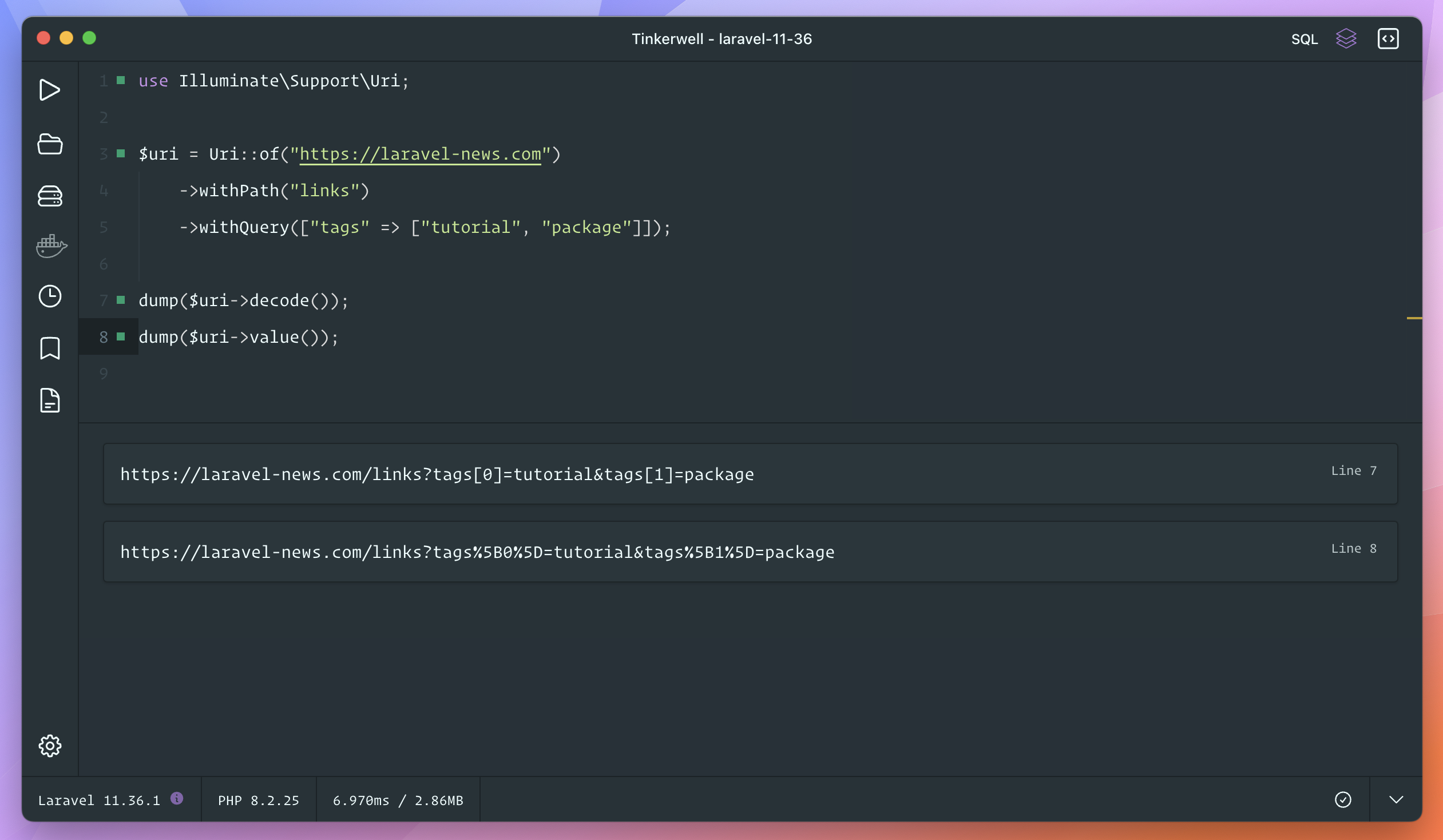
use Illuminate\Support\Uri; $uri = Uri::of('https://laravel-news.com') ->withPath('links') ->withQuery(['page' => 2]) ->withFragment('new'); (string) $url; // https://laravel-news.com/links?page=2#new $uri->path(); // links$uri->scheme(); // https$uri->port(); // null$uri->host(); // laravel-news.comAlso, note the difference between getting the URI value and decoding the URI:
Query Assertion and Manipulation
Asserting and manipulating the URI query params has never been easier in Laravel, using the accompanying UriQueryString under the hood. The UriQueryString class uses the support trait InteractsWithData, which gives you a bunch of useful methods for asserting a query string:
use Illuminate\Support\Uri; $uri = Uri::of("https://laravel-news.com") ->withPath("links") ->withQuery(["page" => 2, 'name' => '']) ->withFragment("new"); $uri->query()->all(); // ["page" => "2"] $uri->query()->hasAny("page", "limit"); // true$uri->query()->has("name"); // true$uri->query()->has('limit'); // false$uri->query()->missing('limit'); // true $uri->query()->filled('page'); // true$uri->query()->filled("name"); // false$uri->query()->isNotFilled("name"); // true$uri->query()->isNotFilled("page"); // false $uri->query()->string("page", "1"); // Stringable{ value: 2 }$uri->query()->integer("limit", 10); // 10Learn about all the useful methods that InteractsWithData provides to the UriQueryString instances to assert and manipulate query data.
Get an Uri Instance from Named Routes, Paths, and the Current Request
The Uri class can also create a URI from a named route in your application, a relative URL, or even from the current Request instance:
// Using a named route(string) Uri::route("dashboard"); // http://laravel.test/dashboard // Using a root-relative URL(string) Uri::to("/dashboard"); // http://laravel.test/dashboard // From the current requestfunction (Request $request) { (string) $request->uri(); // http://laravel.test/dashboard}As of Laravel 11.36, the Uri class is aliased by default in Laravel applications, meaning you can use it without importing the Illuminate\Support\Uri namespace.
Learn More
We hope you enjoy using Uri in your Laravel applications! The Uri class was released in Laravel 11.35 in #53731. Also, read up on InteractsWithData, which provides a ton of useful methods for working with the Uri class, the Fluent class, and Laravel's HTTP Request class (via InteractsWithInput).