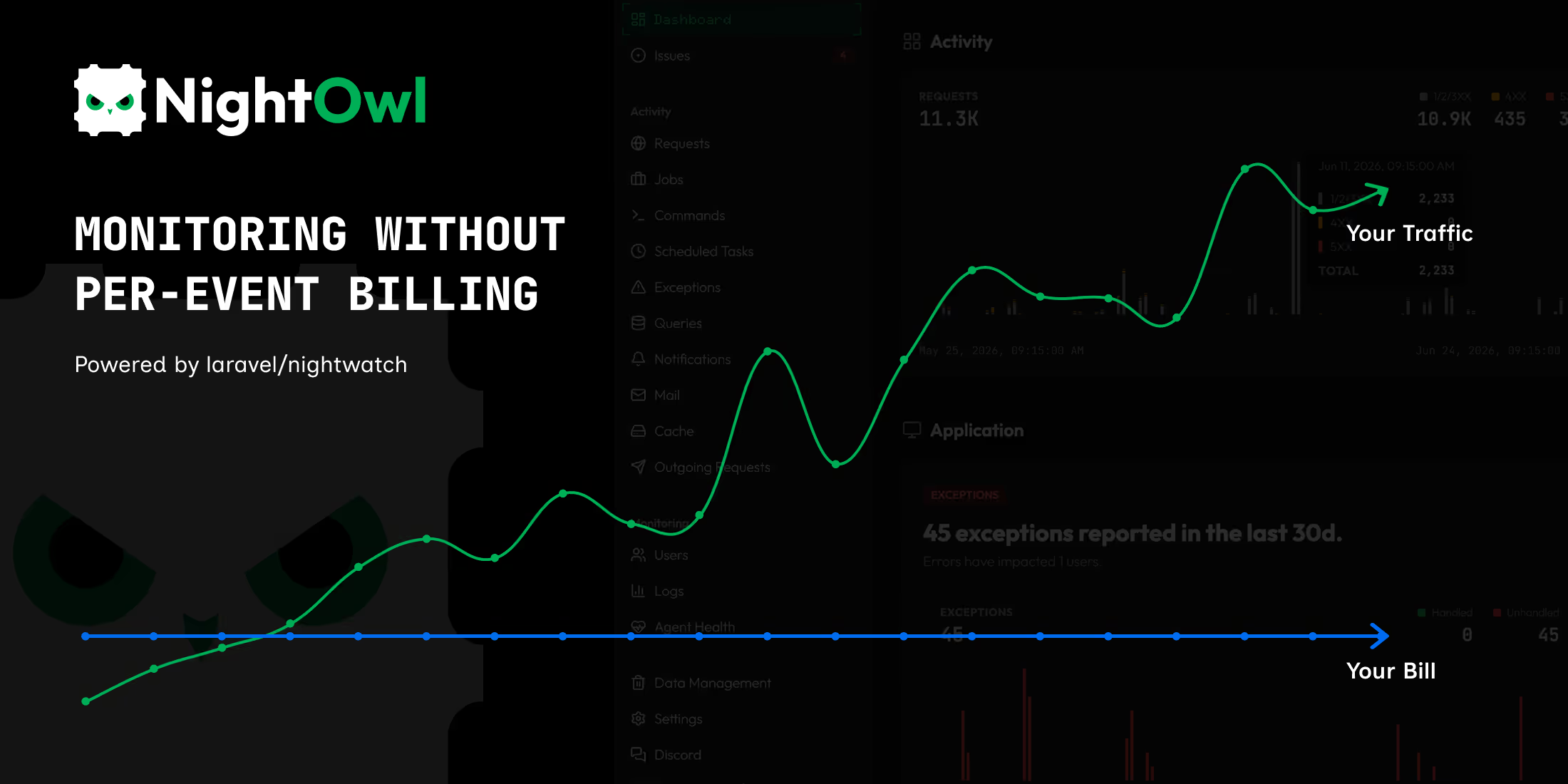
Laravel-specific monitoring has gotten really good these last few years, and almost all of it has converged on the same shape: a hosted service that bills by event volume, with retention as one of the tiers. NightOwl is for the apps where that shape hurts. It keeps the Laravel-native monitoring experience, but the telemetry lives in a PostgreSQL database you own, at a price that stays flat whatever your traffic does.
We built it for our own ERP first. An ERP throws off a mountain of events and not a cent of new revenue with them, and a content site or an internal tool sits in the same spot. Getting billed by traffic when traffic isn't what pays you is a strange place to be.
Retention pushed us the rest of the way. Some of the hardest production issues aren't failures. They are successful requests with the wrong business outcome, and those often surface weeks or months later, when a customer reports them. By then you need the history (requests, jobs, queries, logs). We treat a few months of retention as a practical minimum, and when history is a pricing tier, keeping more of it means paying more for it. We wanted retention to be a storage decision, not a billing one.
If you run an agency, the whole pitch fits in one line: $69/month, unlimited client apps, no per-event fees. And if you're under GDPR or a data-residency contract, telemetry that stays on infrastructure you control was never a preference anyway.
How it works
NightOwl is intentionally simple. It builds on the official laravel/nightwatch package and redirects its telemetry into your own Postgres. From there retention is bounded by disk instead of a pricing tier, and cost stops tracking traffic. That's what lets us keep pricing flat: from $5/month for hobby projects up to the $69 agency plan. If you need everything inside your own walls, there's also a self-hosted license where ingestion and dashboard both run on your infrastructure.
Telemetry isn't user-facing. A handful of engineers read it, not a million users, so it rarely needs cloud-scale infrastructure behind it. And if you're wondering whether PostgreSQL can take the write volume: with the pipeline designed properly, a single instance handles 13,400+ payloads per second, well past what a typical Laravel app produces. And that's not just a load-test number: we have users handling ~300k requests a day, others at ~1M and ~4M, and the biggest for now at ~8M.
Should you try it?
The tool is new (building started late 2025 for internal use, officially released to the public in May 2026), built by people you don't know, so some healthy skepticism is fair.
Rather than a feature list and screenshots, here's a demo you can browse, and the package that powers all of this is open source.
We also got an elder to share his thoughts on the tool.
If you need predictable pricing, retention with granular control over what you keep, or telemetry that stays on your own infrastructure, that's the combination we built for. There's a 14-day free trial at usenightowl.com. Thanks for reading.